
Domains of AI-Awareness for Education Copyright © 2025 by Dani Dilkes is licensed under a Creative Commons Attribution-NonCommercial-ShareAlike 4.0 International License, except where otherwise noted.
Centre for Teaching and Learning, Western University
London, Ontario
Domains of AI-Awareness for Education Copyright © 2025 by Dani Dilkes is licensed under a Creative Commons Attribution-NonCommercial-ShareAlike 4.0 International License, except where otherwise noted.
I
This resource provides an overview of key considerations when exploring the impact of generative AI on Teaching and Learning. It is built around 7 domains of AI-Awareness: Knowledge, Skill, Ethics, Values, Affect, Pedagogy and Interconnectedness. You can dive into the sections that align with your specific questions and interests in generative AI.
Throughout, there will be opportunities to reflect and to engage in different activities designed to allow you to explore the domains of AI-Awareness. At the end of each section, you can reflect on your own level of awareness within each domain.
These will be indicated as follows:
 | Activity: These invite you to try out techniques, tools, or other applications of key concepts from related to each domain. |
 | Making Connections: These reflection prompts invite you to make connections between the different domains of AI-Awareness. |
 | Awareness Reflection: These activities provide opportunities to reflect on and share your awareness of each domain. |
 | Stop and Reflect: These activities invite you to consider the impact of AI technologies in our daily lives. |
This resource is intended for anyone working in a higher education space, but was developed at Western University. Throughout, there will be some specific references to Western resources and policies. You are encouraged to seek out similar information at your own institutions.
The generative AI landscape, including the capability of generative AI, information about the social impact, and other details are constantly and rapidly evolving. This resource should be considered a living resource and will be updated regularly to reflect changes.
If you have feedback, would like to report inaccuracies, typos, or other issues, please contact me at ddilkes2@uwo.ca or submit your feedback anonymously here.
This resource was last updated on 22-August-2025. You can find the revision history here.
The introduction of generative AI has had an unsettling effect on the education landscape. It has surfaced questions about the nature of knowledge production, the design of assessment, the roles of both learners and instructors within the learning environments, and the purpose of education broadly.
There are also increasing demands for educators and students to develop AI Literacy, which can be understood broadly as the ability to understand and use generative AI technologies. Many AI literacy frameworks are built upon an assumption that generative AI use is either desirable and/or inevitable; thus, focused on building capacity to use these technologies effectively through the development of knowledge and skill, often with an ethical or human-centred lens (Hibbert et. al., 2024; UNESCO, 2024; Stanford Teaching Commons, n.d.).
Common across many definitions of AI Literacy include the ability to:
(Ng et. al., 2021; Miao and Cukurova, 2024, Becker et. al., 2024)
However, many AI Literacy frameworks fall short of critical engagement with AI technologies and practices, including allowing for the possibility to choose to not use generative AI technologies. Furthermore, they often fail to recognize the socioemotional aspects of AI discourse.
As an alternative, the Domains of AI-Awareness Framework shifts the focus from use to critical awareness, arguing that this awareness is essential for making informed decisions about generative AI adoption and the development of new pedagogical practices.
This framework expands on the typical focus on knowledge and skills and includes:
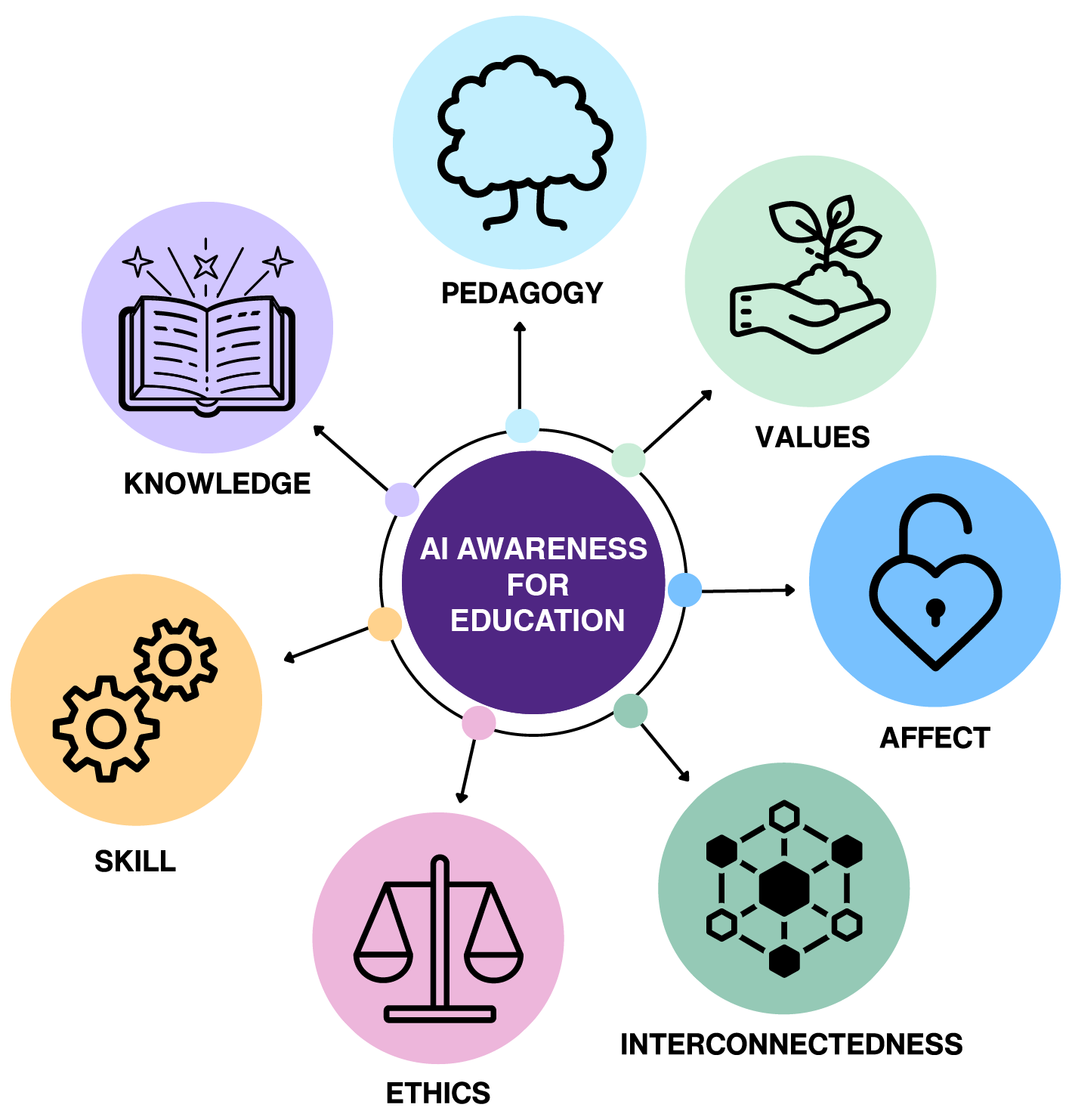
Knowledge: What do educators need to know about how generative AI works, how it’s trained, and how it’s developed?
Ethics: What ethical considerations do educators need to be aware of when choosing to use/not use generative AI?
Value: How do an educator’s fundamental values impact their pedagogical practices and their approach to generative AI? How can an educator’s values conflict with the values of peers or organizations?
Affect: How can educators navigate their emotional response to generative AI technologies and to others with different values or practices?
Skill: What skills are required by educators and learners to use generative AI technologies effectively?
Pedagogy: What impact can generative AI technologies have on teaching and learning? How can we reimagine education to minimize the negative impact and maximize the positive potential?
Interconnectedness: How are generative AI technologies and practices impacted by larger institutional, social, and political factors?
To get started, click on any of the sections below:
Domain of AI-Awareness for Education

Part 1: Foundations of Generative AI (Knowledge)
 Part 2: Ethical Considerations of Generative AI (Ethics)
 Part 3: A Values-Based Approach to Generative AI (Values)

Part 4: Emotional Considerations of Generative AI (Affect)

Part 5: How to use Generative AI (Skill)

Part 6: Teaching & Learning with Generative AI (Pedagogy)
I
1
Artificial Intelligence (AI) is a quickly evolving field with increasing impact on our daily lives. Generative AI is only one subfield of AI, but it has had (and will continue to have) a profound impact on how we produce knowledge and information media.
By the end of this section, you will be able to:

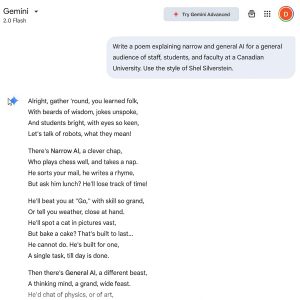
Generative AI is a type of Artificial Intelligence that creates new content, including text, images, videos, audio, and computer code. It is trained to identify patterns, relationships, and characteristics of existing data, and then mimic those patterns and relationships when creating new content. It is called “generative” because it generates new content based on these patterns. For example, the image on the right shows a new piece of artwork in the style of Gustav Klimt. Below, is an AI Generated poem in the style of Shel Silverstein generated in March 2025 using Google Gemini. As discussed in the Ethics section, although generative AI technologies are quite good at mimicking style, the ability to mimic writing and art styles of specific authors and artists has led to numerous controversies around intellectual property and copyright.
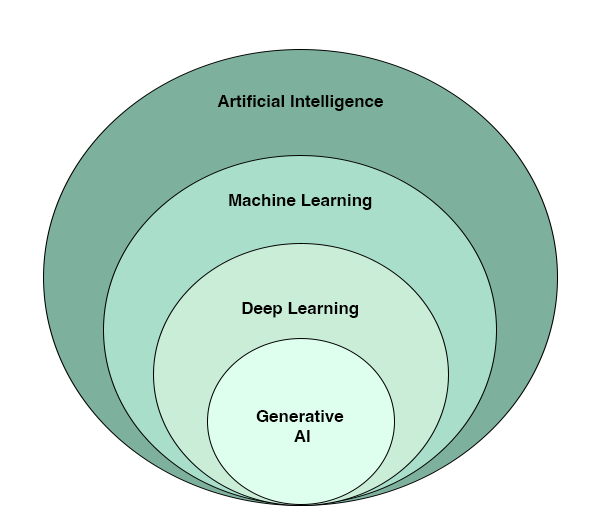
Artificial Intelligence (AI) are technologies that can simulate human intelligence by performing tasks that require the ability to reason, learn, and act independently. In popular media, AI is often represented as nearly indistinguishable from humans (for example the Cylons in Battlestar Galactica  or the Replicants in Bladerunner ). In the present, AI systems are not quite this advanced, but they are becoming more advanced and able to tackle increasingly complex tasks.
Generative AI models are a specialized type of Artificial Intelligence built using Deep Learning techniques to create new content. Deep Learning systems are modelled on the neural networks in the human brain, which allows them to perform very complex tasks like image and speech recognition and generation.
Some generative AI models are Large Language Models (LLMs). LLMs are specifically trained for natural language processing and production tasks. They are pre-trained on large amounts of text, and from this text they learn patterns of syntax and semantics in human language. Large Language Models are used in both discriminative and generative AI systems, meaning that they can be used to both classify new input (for example, to decide if a new email message is spam or not) and to generate new content (for example, to write a new email message asking for an extension on a piece of work).
LLMs are typically general-purposed, meaning that they are trained to solve common language problems. They can be used for:
Examples of Large Language Models include GPT-4, Claude, Gemini, and LlaMA.
Pre-trained LLMs can be further trained on a smaller task or domain specific datasets to allow them to achieve better results or perform specialized tasks. This process is called fine-tuning. For some LLMs, fine-tuning can be done by the end user.
For example, imagine that we wanted to create a TA ChatBot for a course on Information Ethics. An existing LLM would have the foundational understanding of language and perhaps some knowledge on the topic but may not have the specialized knowledge of all of the content covered in the course. This model could be fine-tuned using all of the course readings, lectures, and other course content. This would increase its ability to respond accurately to specific course questions.
Diffusion Models are another type of deep learning that can be used to learn and replicate patterns in visual data. Many image or video generating tools use Diffusion Models. Examples of image-generating diffusion models include Adobe Firefly, MidJourney, DALL-E, and Stable Diffusion.

Most of the examples and activities in this resource will focus on LLMs.
ChatBots are one example of a modern user interface that has made access to generative AI models much easier for the general public. ChatBots are designed to simulate human conversation by accepting natural language prompts or inputs and producing responses in natural language. They can be built on LLMs, allowing them to provide sophisticated responses to prompts. Note that not all chatbots are generative; many are rule-based, meaning they have a set of pre-defined responses to prompts and do not generate unique or original text.
Popular generative AI ChatBots include:
(accessible with your UWO credentials)The functionality of these tools is constantly changing; however, currently many of these tools are able to accept multiple types of input (e.g. text, images, files) and produce multiple types of output.
AI technologies are embedded in many other technological tools and processes. Examples of other places you may encounter AI on a daily basis include:
 Stop and Reflect: Where is AI?
As you use different technologies over the next 24 hours, make note of where you are noticing AI capabilities appearing. What do these tools do? How does AI add to the functionality of the technology?
2
The AI model is pre-trained on a large dataset, typically of general texts or images. For specialized AI models, they may be trained on a specific dataset of subject or domain specific data. The AI analyses the data, looking for patterns, themes, relationships and other characteristics that can be used to generate new content.
For example, early models of GPT (the LLM used by both ChatGPT and Copilot) were trained on hundreds of gigabytes of text data, including books, articles, websites, publicly available texts, licensed data, and human-generated data.
Human intervention can occur at all stages of the training.
Humans may:
The model is then released for use and can be accessed by users
LLMs generate text in response to a user-provided prompt.
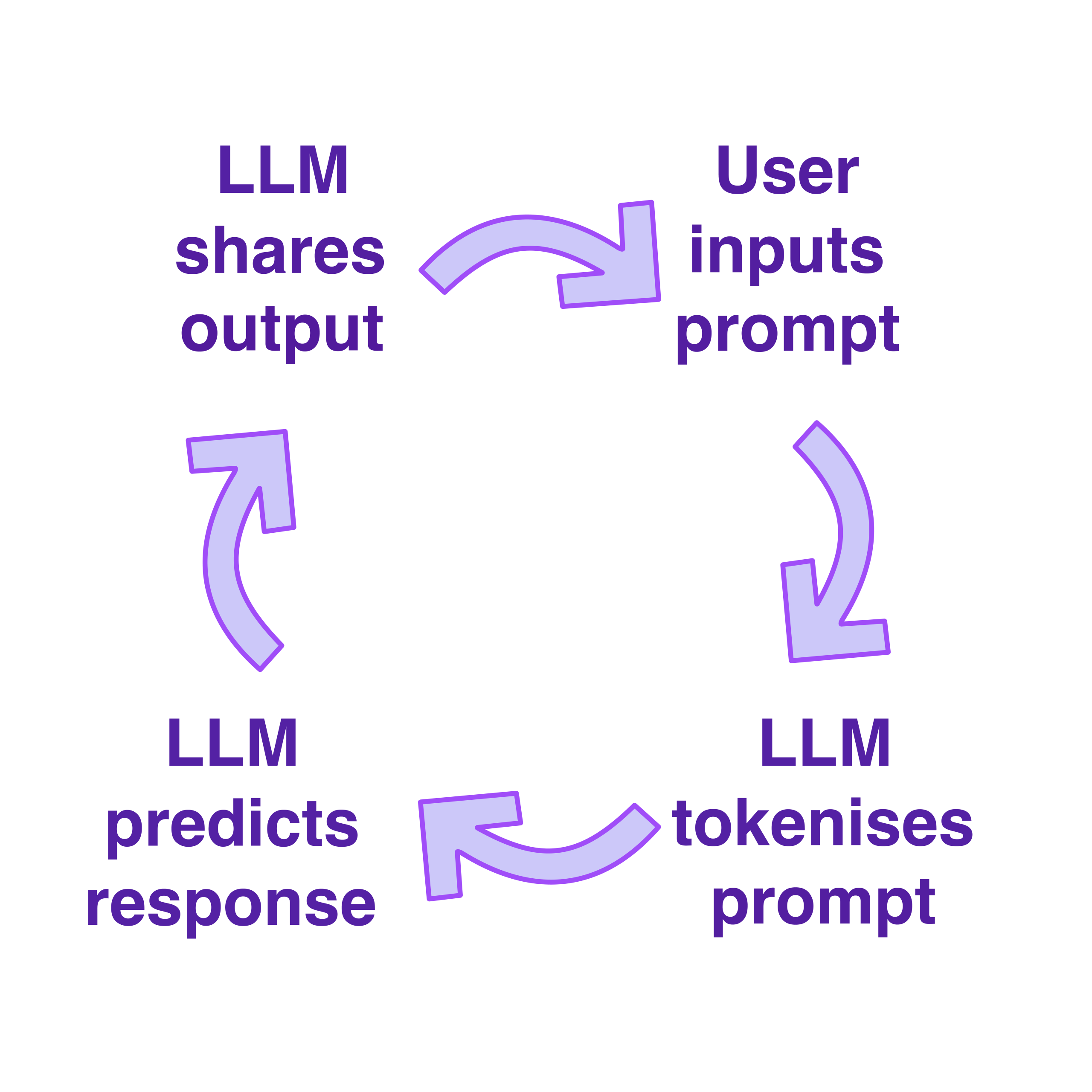
A user provides a prompt, asking the AI model to perform a specific task, generate text, produce an image, or create other types of content.
Prompt: Tell me a joke about higher education. The AI breaks the prompt into tokens (words or parts of words or other meaningful chunks) and analyses these tokens in order to understand the meaning and context of what is being asked.
Token Breakdown: ["Tell", "me", "a", "joke", "about", "higher",
"education", "."]
NOTE: words might also be broken into subword tokens like “high”, “er”, “edu”, “cation”]
These tokens are then converted into vectors (numerical values) that represented the position of the token in relationship to other tokens, representing how likely they are to occur in sequence.
The LLM analyses the vectors and, based on the patterns and other information learned in training, the AI model will start to predict a response to the prompt based on the probability of response tokens appearing in sequence.
For example, in responding to our request to generate a joke, the most likely starting token may be “Why”, “What”, “Here’s” etc.
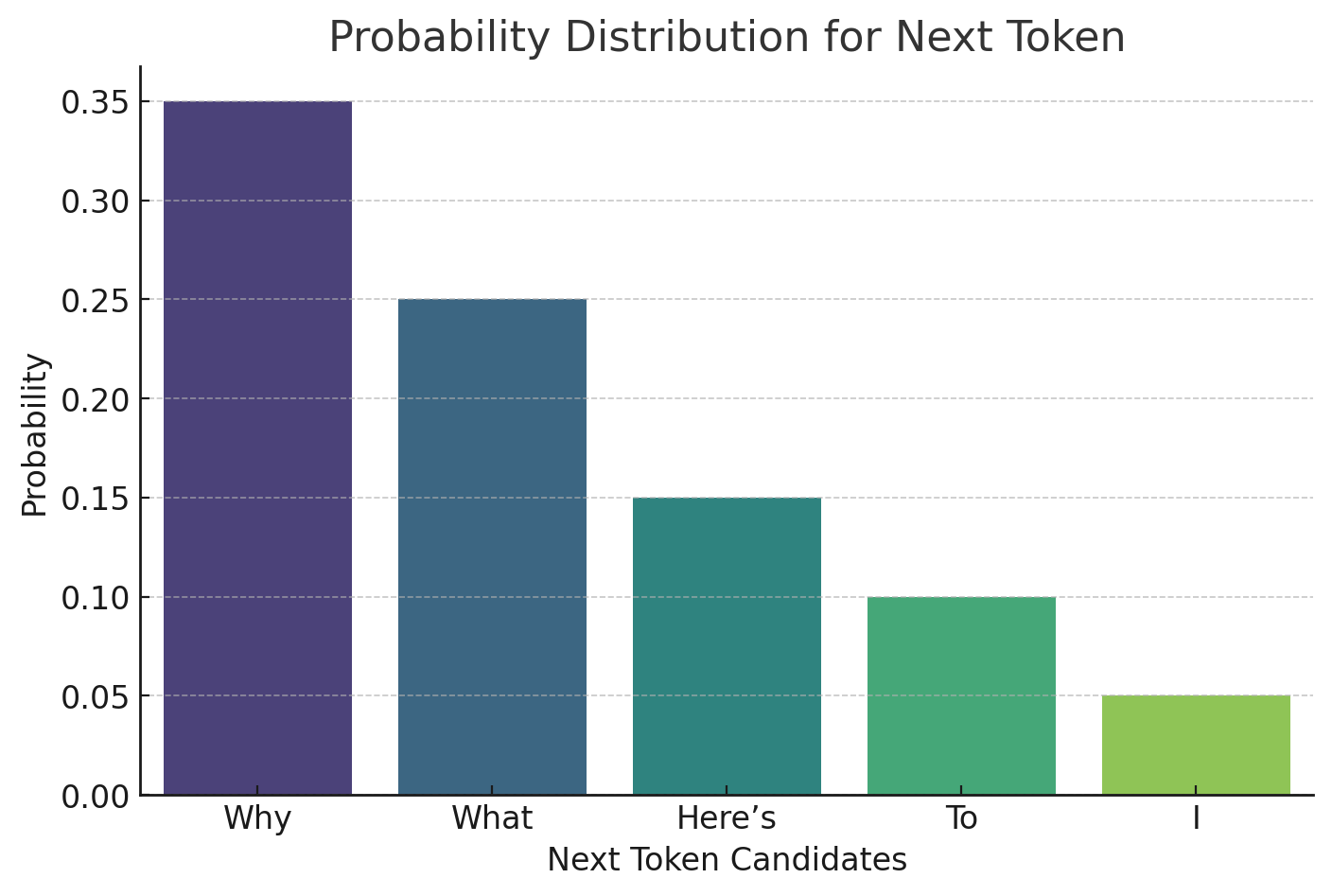
Although Large Language Models do generate output based on probability, they do this using millions or billions of parameters, so often the process of generating is so complex that creators and users don’t really know how they work. This opaqueness is why AI systems are often referred to as a black box, making generative AI systems vulnerability to unseen biases, vulnerabilities, and other problems.
After predicting a sequence of tokens, the LLM decodes the tokens back into natural language (words and sentences readable by a human). The complete response is shared with the user.
✅ “Why did the student bring a ladder to class? To reach higher education!”
The user can then submit a follow-up request referencing the original request or output. This is called iteration.
For more a more detailed introduction to generative AI, see this video from Google:
For a more in-depth look at how LLMs function, see this article from the Financial Times:
Generative AI exists because of the transformer 
Generative AI is evolving quickly but still has certain limitations. Large Language Models (LLMs) are constrained by the data upon which they are trained and the methods through which they are trained. It’s important to be aware of the limitations of the tools that you’re using, especially if currency or accuracy is important for the tasks that you’re using generative AI to complete.
.3
Generative AI is a specific type of advanced Artificial Intelligence that is able to generate new content (text, images, audio, video, etc.) based on prompts.
Large Language Models are a prevalent generative AI model. These are AI models trained on massive datasets of textual data to allowing them to process natural language and perform general language tasks. LLMs typically generate responses based on probability of certain words or tokens appearing in a sequence.
Generative AI has many limitations but is constantly evolving and improving.
Limitations include:
 Making Connections
An interactive H5P element has been excluded from this version of the text. You can view it online here:
https://ecampusontario.pressbooks.pub/aihighereducation/?p=308#h5p-4
 Awareness Reflection: Knowledge
An interactive H5P element has been excluded from this version of the text. You can view it online here:
https://ecampusontario.pressbooks.pub/aihighereducation/?p=308#h5p-3
An interactive H5P element has been excluded from this version of the text. You can view it online here:
https://ecampusontario.pressbooks.pub/aihighereducation/?p=308#h5p-51
4
Financial Times Visual, Data & Podcasts. (2023, September 11). Generative AI exists because of the transformer [Interactive graphic]. Financial Times. https://ig.ft.com/generative-ai/
Schmid, P. (2025, June 30). The new skill in AI is not prompting, it’s context engineering. Retrieved August 21, 2025, from https://www.philschmid.de/context-engineering
Stryker, C. (n.d.). What is agentic AI? IBM. Retrieved August 21, 2025, from https://www.ibm.com/think/topics/agentic-ai
University of Waterloo Library. (2025, May 22). ChatGPT and generative artificial intelligence (AI): Incorrect bibliographic references [Web page]. University of Waterloo. https://subjectguides.uwaterloo.ca/chatgpt_generative_ai/incorrectbibreferences
Wikipedia contributors. (n.d.). Cylons. In Wikipedia… the free encyclopedia. Retrieved August 17, 2025, from https://en.wikipedia.org/wiki/Cylons
Wikipedia contributors. (n.d.). Replicant. In Wikipedia… the free encyclopedia. Retrieved August 17, 2025, from https://en.wikipedia.org/wiki/Replicant
YouTube. (2023, May 8). Introduction to generative AI [Video]. YouTube. https://www.youtube.com/watch?v=G2fqAlgmoPo
II
5
There are many ethical issues around the creation and use of generative AI tools that need to be taken into consideration as we make decision on if/how to adopt generative AI tools into our teaching and learning practices. The goals of this chapter aren’t to impose a certain ethical position on you, but to raise awareness of different ethical concerns and enable you to make decisions that align with your own ethical position. It’s also important to be aware that learners and colleagues may have ethical views different to your own. These differences will impact individual use of generative AI and how you talk with others about AI. We will talk about this more in the sections on Affect and Values as well.
By the end of this section, you will be able to:
Some key ethical considerations are:
In this section, we’ll introduce case studies to help you think about the various ethical implications.
6
A key ethical issue around the training and use of generative AI tools is understanding how data is being used. Privacy, intellectual property and copyright all need to be considered at all stages of generative AI development and use, including text and data mining (TDM), prompting, and the output of generative AI tools.
As we learned in the first section, generative AI is trained on massive datasets of texts and images. These datasets may include copyrighted or otherwise protected data or works.
In fact, multiple lawsuits have been filed against generative AI companies because of suspected unethical use of copyrighted content for training.
Ongoing discussions in Canada and abroad have focused on whether AI training and TDM require permission from copyright holders or should be an exception to copyright law (Government of Canada, 2025 ; WIPO, 2024 ). These discussions are ongoing as of early 2025.
Another question of Intellectual Property is the information and data that is entered into generative AI tools by users. Different tools have different policies around the collection and use of personal data, including the data required to set up an account and any information included in prompts. Users may inadvertently provide personal or sensitive data in their prompts or queries to AI systems, many of which are saved, stored, and used by companies for training or other purposes.
Data is typically grouped into three risk levels:
The Freedom of Information and Protection of Privacy Act (FIPPA) states that you can only use personal information for the purpose it was collection and prohibits the use of an individual’s personal information for other purposes without their consent. The answers in completed assignments, exercises, exams, etc., are considered to be the personal information of the student. (See Western’s statement on FIPPA ).
Before adopting new technologies, it’s important for instructors to review and fully understanding the privacy, security and data management policies and practices of the tool and encourage students to do the same. It’s also important to understand the settings and features of each tool. For example, some tools may have settings that allow you to exclude your prompts from training data or create a temporary chat.

 Activity: Privacy Policies
Look at the privacy policy for a generative AI tool that you’re familiar with or interesting in exploring.
An interactive H5P element has been excluded from this version of the text. You can view it online here:
https://ecampusontario.pressbooks.pub/aihighereducation/?p=416#h5p-14
See Western’s Cyber Security Awareness Training for more information on safe digital practices regarding privacy.
Intellectual Property is also an important consideration when using generative AI. Any information included in your prompts is subject to existing copyright laws. It’s important to ensure that you have permission to use any content (text, images, data, etc.) that you are including in your prompts.
When considering using generative AI tools to support teaching and learning, it’s especially important to keep in mind that any work created by a student as part of their academic studies is their Intellectual Property and subject to the same copyright laws. (see Policy 7.16 – Intellectual Property ).
Consider the cases below to examine how privacy, copyright and intellectual property might impact the use of generative AI tools.
Ethical Case Study: Privacy and Consent
A popular video conferencing platform has introduced a new AI-based tool which can be used to summarize meetings, generate action items, summarize the chat, organize ideas, and more. This tool can be turned on by the meeting host. Users may opt out only by leaving the Zoom session.
What ethical considerations are there around using this tool?
This introduces issues of privacy and consent as well as respecting individuals’ choice to opt-out of AI-use. If an instructor is using Zoom for virtual classes, they may turn on this tool in the Zoom session. If students would prefer to not have their data and contributions to the meeting used to train the AI, their only option is to leave the Zoom session. This presents inequitable access to course activities conducted through this platform. Instructors should consider obtaining full informed consent from all students in the class and refraining from using this tool if this consent is not granted by every student.
Ethical Case Study: Intellectual Property & Copyright
You are fine-tuning a Large Language Model to help your TAs with grading papers. You plan to train the LLM on all of the student submissions you’ve collected for an assignment from the past 3 years and work with it to accurately assess new papers.
What ethical considerations need to be made before moving ahead with this?
Intellectual Property – if students didn’t grant you permission to use their work in this way, it is unethical and against UWO policy to do so.
Privacy – Some student submissions may also include personal data that should not be used for training or course exemplars, including their name, student number, or personal reflections or information in the submission itself. Even if consent is received, it’s important to remove any possibly identifying data and ensure that you’re only sharing low-risk data.
Another question of Intellectual Property & Copyright arises with the output generated by generative AI models. The question that has been raised is whether or not works produced by non-human tools can be copyrighted. Currently, the discussions in Canada suggest that in order to be copyrighted, a work must have sufficient human input (Government of Canada, 2025 ). Works produced with generative AI may also raise concerns about copyright infringement if they are too similar to existing works.
Ethical Case Study: Intellectual Property & Copyright
You are an instructor for a first-year business course. You have elected to using generative AI to create a series of business cases to teach key concepts rather than paying for proprietary cases. You generate the cases and make revisions, as necessary. The cases work very well for your class, so you decide to share them under an open license for other instructors to use. A major publisher contacts the open library where you have shared the cases and requests that the content be removed claiming it is a copyright infringement because the cases very closely resemble materials in their collection.
What are the ethical considerations in this scenario?
Because generative AI is not transparent, it is impossible to identify the sources that it was trained on and whether or not the generated output includes ideas or elements of copyrighted content.
Copyright laws and standards for providing credit to training data are still evolving, so there is not a clear process for checking for copyright infringement or acknowledging the works used to train AI.
At a minimum, it should be clearly acknowledged if/when content is generated with the assistance of AI. More information on how to cite AI-use is shared in the section on Pedagogy.
7
Any technology presents issues of equitable access related to cost. Even tools that are free often offer a more feature-rich or advanced version at a cost. When allowing or encouraging students to use AI tools, it’s important to be aware that many students may not be able to afford access to certain tools or to premium licenses. When designing assignments or activities, ensure that this won’t unfairly advantage students who are able to access the paid versions of these tools.

Another important consideration when adopting any new tool for teaching is the accessibility of the tool. This means ensuring that every learner is able to access and use the tool.
Basic AODA standards require web-based tools to allow for keyboard navigation and for assistive technology compatibility. A review of the accessibility of AI interfaces conducted by Langara College suggests that many AI tools are not in compliance with AODA requirements or present other accessibility barriers. When evaluating a new technology, like generative AI, review its documentation for information about built-in accessibility features to ensure that they comply with these basic requirements.
It is important to recognize that even technologies compliant with AODA standards may still present barriers to access for some learners. You may need to provide an alternative tool or an alternate way of completing an activity to ensure all students are able to participate.
For more information, see Western’s Policy on Accessibility and the Accessibility Western site .
8

The rapid growth of AI technologies (and cloud-based technologies in general) has sparked a lot of concern around the environmental impact of technological advancement.
There are environmental considerations at each stage of the AI development process:
Hardware: the physical resources required for generative AI hardware and infrastructure involves extensive mining and extraction of minerals, which can lead to deforestation and increased soil and water pollution. The production of hardware, like Graphic Processing Units, can also consumed large amounts of energy and water. (Hosseini et. al., 2025 ). The rapid growth of generative AI technologies will also contribute to the global increase in ewaste, which when not properly disposed of can also contribute to air, water, and soil pollution. A report from 2022 indicates that only 22% of ewaste is properly recycled (Crownhart, 2024).
Training: Training generative AI models requires significant amounts of energy. For example, it has been estimated that creating GPT-3 resulted in carbon dioxide emissions equivalent to the amount produced by 123 gasoline powered vehicles driven for a year (Saenko, 2023 ).
Usage: using generative AI also has a substantial water footprint and significant carbon emissions. It is estimated that a ChatGPT dialogue with 20-50 prompts uses approximately 500ml of water (McLean, 2023 ). Estimates suggest that by 2027, use of AI technologies globally will account for water withdrawal equivalent to 4-6 times that of Denmark or half that of the United Kingdom (Li, Islam & Ren, 2023). However, in contrast, an analysis conducted in 2024 suggests that the carbon emissions of content creation (text and images) may actually be lower for generative AI produced content than human-produced content (Tomlinson, Black, Patterson, & Torrance, 2024).
Data centres, though not limited to generative AI technologies, are becoming one of the largest consumers of energy, currently accounting for 3% of global energy consumption (Cohen, 2024 ). They also require large amount of water for cooling. There are more environmentally sustainable approaches to cooling down data centres, but these are substantially more expensive, which could be seen as another example of values-friction (sustainability VS profitability), as discussed in section 3.2, (Ammachchi, 2025 ).
Often, the largest environmental impact of technological development occurs in already disadvantaged communities, perpetuating existing inequities. For example, a study in the US shows that high-pollutant data centres were more likely to be built in racialized communities (Booker, 2025 ).
Many of these environmental concerns are not new, but generative AI has brought a renewed focus on the environmental impact of digital technologies and rapid technological advancement. The environmental impact is a prime example of the complexity of the generative AI conversation as it highlights tensions in values and priorities, social inequities, and the affective nature of these conversations.
See AI’s impact on energy and water usage for a review of recent research on the environment impact of generative AI technologies.
9

Many AI models are trained on data where social biases are present. These biases are then encoded into the patterns, relationships, rules, and decision-making processes of the AI and have a direct impact on the output.
Biased data can be easy to spot, such as in this AI generated image which shows a predominantly white class of 2023 at Western, but it can also be more invisible. AI-generated text will reflect dominant ideologies, discourses, language, values, and knowledge structures of the datasets they were trained on. For example, Large Language Models may be more likely to reproduce certain dominant forms of English, underrepresenting regional, cultural, racial, or class differences (D’Agostino, 2023 ).
The ethical issue is twofold: first, the information generated by generative AI is more likely to reflect dominant social identities, meaning that students who use AI will not be exposed to certain worldviews or perspectives, and some students may not feel that their experiences and identities are reflected in the output. Second, the use of generative AI to produce knowledge will continue to reinforce the dominance of these ideologies, values, and knowledge structures, contributing to further inequities in representation.
As an instructor, it’s important to be aware of this limitation of AI tools. If you ask your students to use these tools, it’s also important to teach them critical AI literacies to similarly be able to identify and reflect on these issues of representation, bias and equity.
Some generative AI companies have taken steps to correct for biases in the training data by establishing content policies or other guardrails to prevent generating biased or discriminatory output. However, these guardrails are inconsistent and can be subject to the ethical standards of each generative AI company.

Ethical Case Study: Bias
You are testing out a generative AI feedback tool with the hopes that it will be able to provide accurate personalised feedback on student submissions. You decided to review all feedback provided by the tool in detail and compare to your own evaluations. You note that many of the international students in the class received negative feedback on their writing style and coherence.
Large Language Models are trained on datasets biased towards dominant forms of English. The probability models that they use are designed to replicate these dominant patterns of language, which may result in any deviation from these “norms” being treated as errors or problems.
10
Because of the ability to generate plausible information at scale, generative AI technologies have exacerbated the potential harms of misinformation, disinformation and mal-information in a time of information abundance. The generation or dissemination of fake, inaccurate, or misleading information through generative AI could be either unintentional or deliberate.
Misinformation refers to inaccurate or false information that is shared without intending to create harm. This could occur as a result of generative AI users not verifying generative AI outputs before sharing them.
Mal-information refers to information that may be rooted in truth or fact, but removed from context or distorted in ways that can mislead. When using generative AI, this might be the result of inaccurate outputs or hallucinations. Generative AI could also be used by malicious individuals to distort information in a way that is plausible.
Disinformation refers to inaccurate or false information that is shared with malicious intend, to mislead recipients or manipulate decision-making or perspectives. Generative AI could be used to generate fake news stories, fake datasets, or otherwise employed in attempts to deceive at large scales.
(Canadian Centre for Cyber Security, 2024; Jaidka et. al., 2025)
One of example of this is the use of text-to-image and text-to-video generative AI tools to produce visual media for the purposes of (malicious or not) deception. A deepfake is the product of generative AI that creates a believable but fake video, audio, or image. They often feature real people saying or doing something that they didn’t really say or do. Deepfakes do have potential benefits for the arts, for social advocacy, for education and for other purposes, but they do present ethical issues because often permission has not been received to use the person’s likeness and because it has the potential to spread misinformation or to mislead people.
Ethical Case Study: Misinformation & Deception
One of your course assignments asks students to produce a piece of speculative fiction reflecting on the future if immediate action isn’t taken in response to Climate Change. One student creates a video of a news report showing the world in crisis. Within the video, they have deep fakes of several world leaders justifying their lack of action over the past 10 years.
What ethical considerations are there around this use of AI?
Deepfakes present a few important ethical issues, particularly with regards to misrepresentation, intention to deceive, and politics and political agendas. In this case, the student wasn’t necessarily attempting to deceive viewers, but it’s important to help students understand the ethics of generative AI and the potential harms if you allow or encourage AI use in your courses.
11
The field of AI is complex and presents many ethical considerations that need to be considered when using AI.
These ethical considerations include privacy, intellectual property and copyright, the environmental impact, the tendency of AI models to replicate existing social inequities and perpetuate bias, and the ability for AI to be used to spread misinformation.
Instructors should be aware of these ethical considerations and make sure that students are also aware of them if they choose to adopt AI tools in their courses.
The most important thing to remember is that Generative AI tools and use are emergent and constantly and quickly evolving. This means that it will be necessary to keep informed about the changing landscape as our own practices and approaches to teaching similarly evolve.
Making ConnectionsBased on your understanding of Generative AI technologies now:
An interactive H5P element has been excluded from this version of the text. You can view it online here:
https://ecampusontario.pressbooks.pub/aihighereducation/?p=418#h5p-12
Awareness Reflection: EthicsAn interactive H5P element has been excluded from this version of the text. You can view it online here:
https://ecampusontario.pressbooks.pub/aihighereducation/?p=418#h5p-10
An interactive H5P element has been excluded from this version of the text. You can view it online here:
https://ecampusontario.pressbooks.pub/aihighereducation/?p=418#h5p-52
12
Ammachchi, N. (2025, August 19). Water-guzzling data centers spark outrage across Latin America. Nearshore Americas. https://nearshoreamericas.com/water-guzzling-data-centers-spark-outrage-across-latin-america/
Booker, Mario DeSean. (2025). Digital redlining: AI Infrastructure and Environmental Racism in Contemporary America. World Journal of Advanced Research and Reviews. 10.30574/wjarr.2025.27.1.2602.
Canadian Centre for Cyber Security. (2024, May). How to identify misinformation, disinformation and malinformation (ITSAP.00.300). Communications Security Establishment. Retrieved from https://www.cyber.gc.ca/en/guidance/how-identify-misinformation-disinformation-and-malinformation-itsap00300
Chen, M. (2023, January 24). Artists and illustrators are suing three A.I. art generators for scraping and ‘collaging’ their work without consent. Artnet News. Retrieved August 17, 2025, from https://news.artnet.com/art-world/class-action-lawsuit-ai-generators-deviantart-midjourney-stable-diffusion-2246770
Cohen, A. (2024, May 23). AI is pushing the world toward an energy crisis. Forbes. https://www.forbes.com/sites/arielcohen/2024/05/23/ai-is-pushing-the-world-towards-an-energy-crisis/
Crownhart, C. (2024, October 28). AI will add to the e-waste problem. MIT Technology Review. https://www.technologyreview.com/2024/10/28/1106316/ai-e-waste/
D’Agostino, S. (2023, June 5). How AI tools both help and hinder equity. Inside Higher Ed. https://www.insidehighered.com/news/tech-innovation/artificial-intelligence/2023/06/05/how-ai-tools-both-help-and-hinder-equity
Earth.Org. (2023, April 28). The environmental impact of ChatGPT [Web article]. Earth.Org. https://earth.org/environmental-impact-chatgpt/
Hosseini, M., Gao, P., & Vivas-Valencia, C. (2024, December 15). A social-environmental impact perspective of generative artificial intelligence. Environmental Science and Ecotechnology, 23, Article 100520. https://doi.org/10.1016/j.ese.2024.100520
Ippolito, J. (n.d.). 9 takeaways about AI energy and water usage [Web page]. Learning With AI. Version 1.9. Retrieved August 17, 2025, from https://ai-impact-risk.com/ai_energy_water_impact.html
Jaidka, K., Chen, T., Chesterman, S., Hsu, W., Kan, M.-Y., Kankanhalli, M., Lee, M. L., Seres, G., Sim, T., Taeihagh, A., Tung, A., Xiao, X., & Yue, A. (2025). Misinformation, Disinformation, and Generative AI: Implications for Perception and Policy. Digital Government (New York, N.Y. Online), 6(1), Article 11. https://doi.org/10.1145/3689372
Joseph Saveri Law Firm, LLP. (n.d.). GitHub Copilot intellectual property litigation [Web page]. Joseph Saveri Law Firm, LLP. Retrieved August 17, 2025, from https://www.saverilawfirm.com/our-cases/github-copilot-intellectual-property-litigation
Langara College Educational Technology. (n.d.). Accessibility of AI interfaces [Web page]. Langara College. Retrieved August 17, 2025, from https://students.langara.ca/about-langara/academics/edtech/AI-Accessibility.html
Li, P., Yang, J., Islam, M. A., & Ren, S. (2023). Making AI Less “Thirsty”: Uncovering and Addressing the Secret Water Footprint of AI Models. arXiv. https://doi.org/10.48550/arXiv.2304.03271
Ontario. (n.d.). Freedom of Information and Protection of Privacy Act (R.S.O. 1990, c. F.31) [Statute]. e-Laws, Government of Ontario. Retrieved August 17, 2025, from https://www.ontario.ca/laws/statute/90f31
Pope, A. (2024, April 10). NYT v. OpenAI: The Times’s about-face [Blog post]. Harvard Law Review. https://harvardlawreview.org/blog/2024/04/nyt-v-openai-the-timess-about-face/
Saenko, K. (2023, May 25). A computer scientist breaks down generative AI’s hefty carbon footprint. Scientific American. Reprinted from The Conversation US. https://www.scientificamerican.com/article/a-computer-scientist-breaks-down-generative-ais-hefty-carbon-footprint/
Tomlinson, B., Black, R.W., Patterson, D.J. et al. The carbon emissions of writing and illustrating are lower for AI than for humans. Sci Rep 14, 3732 (2024). https://doi.org/10.1038/s41598-024-54271-x
Western Technology Services. (n.d.). Learn It. [Web page]. Western University. Retrieved August 17, 2025, from https://cybersmart.uwo.ca/for_western_community/learn_it/index.html
Western University. (2009, December 1). Policy 1.47 – Accessibility at Western [PDF]. Manual of Administrative Policies and Procedures. University Secretariat. Retrieved August 17, 2025, from https://www.uwo.ca/univsec/pdf/policies_procedures/section1/mapp147.pdf
Western University. (2018, April 26). Policy 7.16 – Intellectual Property [PDF]. Manual of Administrative Policies and Procedures. University Secretariat. Retrieved August 17, 2025, from https://www.uwo.ca/univsec/pdf/policies_procedures/section7/mapp716.pdf
Western University, Office of the Vice-President (Operations & Finance), Legal Counsel. (n.d.). FIPPA – Some basics for faculty and staff [Web page]. Western University. Retrieved August 17, 2025, from https://www.uwo.ca/vpfinance/legalcounsel/privacy/fippa.html#protection
World Intellectual Property Organization. (2024). Generative AI: Navigating intellectual property [Factsheet]. World Intellectual Property Organization. Retrieved August 17, 2025, from https://www.wipo.int/documents/d/frontier-technologies/docs-en-pdf-generative-ai-factsheet.pdf
III
13
Artificial Intelligence is quickly changing how we engage in knowledge production and will have a huge impact on teaching and learning.
By the end of this section, you will be able to:
14
Our values are our fundamental beliefs about what is important. Our values motivate action and impact who we are and how we exist in the world. All individuals hold multiple values simultaneously, but attribute different levels of importance to each value (Schwartz, 2012). The values that an educator holds will impact their pedagogical practices and curricular decisions (e.g. what they teach, how they teach, how they interact with learners, etc.). In particular, your values will impact how you choose to use/not use generative AI tools in your teaching and course design and how you talk about generative AI with your learners. Similarly, the values that a learner holds will impact their decisions around if/how they use generative AI as part of their learning. Recognizing and naming your values may help you better navigate your beliefs and emotional response to generative AI.
Activity: Defining your values1.) Write down all of the values that are important to you. Don’t try and rank them, just write down ideas until you can’t think of any more. You may also find it helpful to refer to the values list below.
| Abundance Acceptance Accountability Achievement Adventure Advocacy Ambition Appreciation Attractiveness Autonomy Balance Benevolence Boldness Brilliance Calmness Caring Challenge Charity Cleverness Community Communication Commitment Compassion Conformity Connection Cooperation Collaboration Consistency Contribution Creativity Credibility | Curiosity Decisiveness Dedication Dependability Diversity Empathy Encouragement Engagement Enthusiasm Ethics Excellence Expressiveness Fairness Family Friendships Flexibility Freedom Fun Generosity Grace Gratitude Growth Flexibility Happiness Health Honesty Humility Humour Inclusiveness Independence Individuality | Innovation Inspiration Intelligence Intuition Joy Kindness Knowledge Leadership Learning Life-long learning Love Loyalty Mindfulness Motivation Optimism Open-mindedness Originality Passion Peace Perfection Playfulness Performance Personal development Popularity Power Preparedness Privacy Proactive Professionalism Punctuality Quality | Recognition Relationships Reliability Resilience Resourcefulness Responsibility Responsiveness Risk taking Safety Security Self-control Selflessness Service Simplicity Spirituality Stability Success Teamwork Thoughtfulness Traditionalism Trustworthiness Understanding Uniqueness Usefulness Versatility Vision Warmth Wealth Wellbeing Wisdom Zeal |
2.) From your list, circle your top 10 values.
3.) Rank your top 10 values in order of importance.
(Adapted from University of Edinburgh’s Values Toolkit)
An interactive H5P element has been excluded from this version of the text. You can view it online here:
https://ecampusontario.pressbooks.pub/aihighereducation/?p=496#h5p-58
Although values do impact decisions and actions, the link between a value and an action or decision is not always direct or obvious. There may be many factors that impact decision making, including different understanding of the value proposition of a decision. For example, one instructor who values inclusivity may encourage the use of generative AI technologies to help support student access needs, reduce language barriers, or provide additional scaffolds; another instructor who values inclusivity may discourage or ban the use of generative AI because not all student may have the resources to pay for a subscription which can result in inequal access for students.
Values friction (conflicting values) may also impact decision-making. Values friction can occur both within an individual and in interactions between an individual and others or between an individual and organizations. When one individual holds multiple values. they can come into conflict with each other (e.g. honesty and compassion; individualism and belonging). Typically, an individual will place different levels of importance on different values, which will affect which values have the greatest impact on decision making or action. However, individuals may also be constrained by the values friction that exists between their own values and peers’ values or institutional values and norms (Jensen, Schott, & Steen, 2021).
Consider the following scenarios and how values may impact decision-making.
Values Case Study: Assignment Feedback
You are teaching a second year global health course that uses case-based assessment. Each week, individual learners need to analyse a different global health scenario and submit a case analysis. In past years, you have always provided detailed feedback to each learner a few days before their next submission is due, to allow them to consider the feedback and make improvements. This year, your class size has increased significantly. Your colleague has shared how they are using genAI to help with feedback generation and suggested you do this to expedite your evaluation.
What values might impact your decision in this scenario?
If your top values include punctuality or reliability, you might decide to use generative AI to provide feedback to ensure that you are able to provide feedback in the expected timeline and honour the commitment that you’ve made to students.
If your top values include authenticity or connection, you might decide to continue to generate feedback manually without the use of generative AI, even if that means a delay in returning the assignments to learners.
If your top values include both reliability and authenticity, you may experience values-friction and struggle to make a decision without feeling discomfort.
Values Case Study: Detecting Generative AI
You are a TA in an upper-year history course. Students need to complete a series of document analyses of primary sources. You have received a number of submissions lately that seem very structurally and grammatically strong, but that lack good analysis. You have a feeling that the students may be using generative AI to complete the assignments. Other TAs in the course have echoed these concerns and shared that they have all adopted an AI-detection tool to help flag AI-generated submissions. They’ve encouraged you to do the same.
What values might impact your decision in this scenario?
If your top values include trust, you may feel uncomfortable using an AI-detection tool to identify academic misconduct since it impacts the educator-student relationship and assumes dishonesty.
If your top values include conformity or fairness, you might decide to use the AI-detection tool to align with the group consensus and to ensure that all students in the course receive a similar experience.
Values Case Study: Zoom AI Companion
You teach an Introduction to Environmental Science course online over Zoom. Recently, one of your students has requested to use the embedded AI tool, which records the meeting, generates a transcript and produces a summary with key concepts. The student says that this will help them take better notes and support their learning.
What values might impact your decision in this scenario?
If your top values include accessibility or inclusiveness, you might decide to allow the use of the AI companion tool, or even use it yourself and share the summaries with the whole class.
If your top values include privacy, you might be reluctant to use the AI companion because it records student interactions. You may also have concerns around how the data is stored or if it might be used for purposes beyond the course, such as training.
Values Case Study: Image Generation
You are teaching an introduction to anatomy class. Your course materials include a lot of visuals, which you have typically taken from standard textbooks and online repositories. However, most of the images available to you portray light-skinned, able-bodied males. You are considering using generative AI tools to generate more diverse images for your course materials.
What values might impact your decision in this scenario?
If your top values include inclusiveness, you might move ahead with using generative AI tools to generate more diverse images. However, you may also have concerns about the potential for biased or discriminatory representation in AI-generated images.
If your top values include sustainability, you might also have concerns about the potential energy costs of using generative AI to generate images compared to the costs of finding existing images.
Values are intrinsically linked to affect or emotion (Schwartz, 2012). When our values are threatened or questioned, it can activate a negative emotional response. Similarly, when our values are realized, it can activate a positive response. For more information on how to navigate the affective nature of generative AI, see the section on Emotional Intelligence.
Awareness Reflection: Your Pedagogical ValuesAn interactive H5P element has been excluded from this version of the text. You can view it online here:
https://ecampusontario.pressbooks.pub/aihighereducation/?p=496#h5p-29
15
One of the most pressing issues of generative AI on education is how it will reshape assessment and potentially redefine the meaning of original work and plagiarism.
The International Centre for Academic Integrity defines Academic Integrity as a mutual commitment to 6 fundamental values: honesty, trust, fairness, respect, responsibility, and courage (ICAI, 2021)
The student, the instructor, and the institution all play an important role in creating a culture of Academic Integrity.
The institution is responsible for
The instructor is responsible for
The student is responsible for decisions and actions they take regarding academic integrity.
Awareness Reflection: An Instructor’s RoleAn interactive H5P element has been excluded from this version of the text. You can view it online here:
https://ecampusontario.pressbooks.pub/aihighereducation/?p=812#h5p-45
Instructors have several choices when approaching generative AI though the lens of academic integrity. Should they:
Ignoring generative AI and continuing on as usual may seem like the easiest option for instructors. However, doing so fails to address several fundamental values of Academic Integrity: trust, fairness, responsibility, and courage.
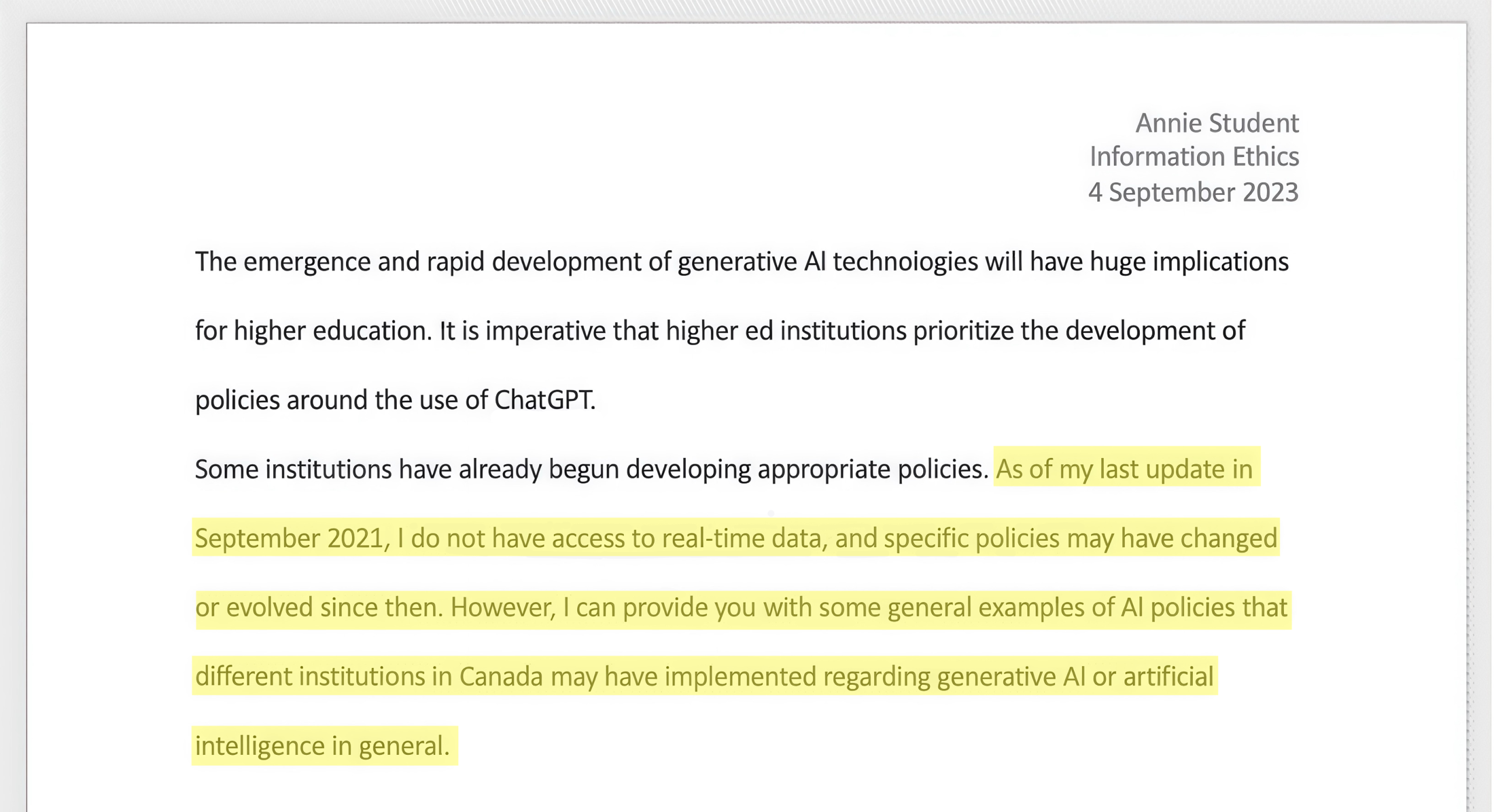
The absence of an AI policy or practices will not prevent its use. You will still encounter student submissions that you suspect (or know) to be generated with the assistance of AI, as demonstrated in the below image. When this happens, you will need to decide how to address it. Without establishing clear expectations around AI use, this process lacks transparency (a core characteristic of trust) and will impede the ability to apply policies equitably (fairness).
Responsible faculty acknowledge the possibility of academic misconduct and create and enforce clear policies around it. Academic Integrity also requires a willingness to take risks and deal with discomfort (courage).
It’s clear that institutions and instructors need to take some action in response to generative AI. The immediate reaction of many institutions and instructors may be to implement a blanket ban on AI use.
However, completely prohibiting the use of AI could also been seen to fail to address multiple fundamental values of Academic Integrity. It is also unrealistic, as generative AI tools are embedded in many other applications (such as Microsoft Word and web browsers).
This approach lacks: respect, responsibility, trust, courage, honesty, and fairness.
A blanket ban will contribute to a culture of mistrust as it could be seen to be built on the assumption that students’ most likely use of generative AI tools would be to commit scholastic offenses. It also ignores the opportunities generative AI offers to support and deepen learning.
Some students will absolutely use generative AI in inappropriate ways. However, many other students may benefit from it as a tool to enhance and improve learning and provide supports for diverse learners.
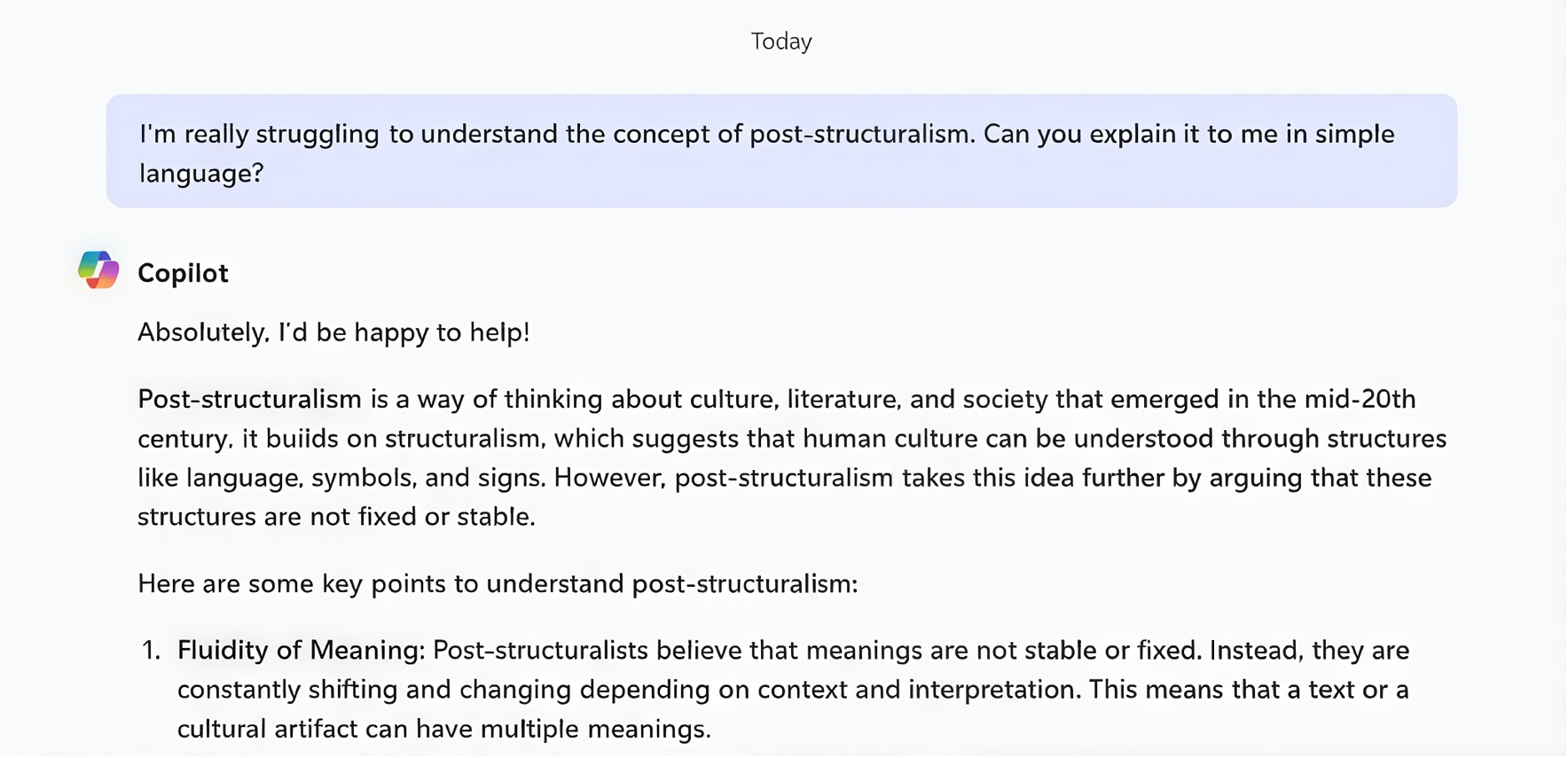
Students will also encounter AI tools in their future careers and studies, so by choosing to not consider AI in our teaching, fields, and course designs, we may be failing to prepare students for the future.
Our goal as instructors is to demonstrate respect for the motivations and goals of all learners while still being able to hold individuals responsible for their actions.
A blanket ban of generative AI lacks Trust in students’ ability to use generative AI responsibly and denies them the opportunity to develop important AI literacies. It also lacks the courage to explore if/how AI can enhance our disciplines and teaching and learning practices. Of course, there may be times when it is not appropriate for students to use generative AI tools, particularly if it interferes with students demonstrating the learning outcomes of the course. The key thing to consider is whether it is necessary to prohibit tools and, if it is, that you can clearly explain to students why.
Detecting generative AI
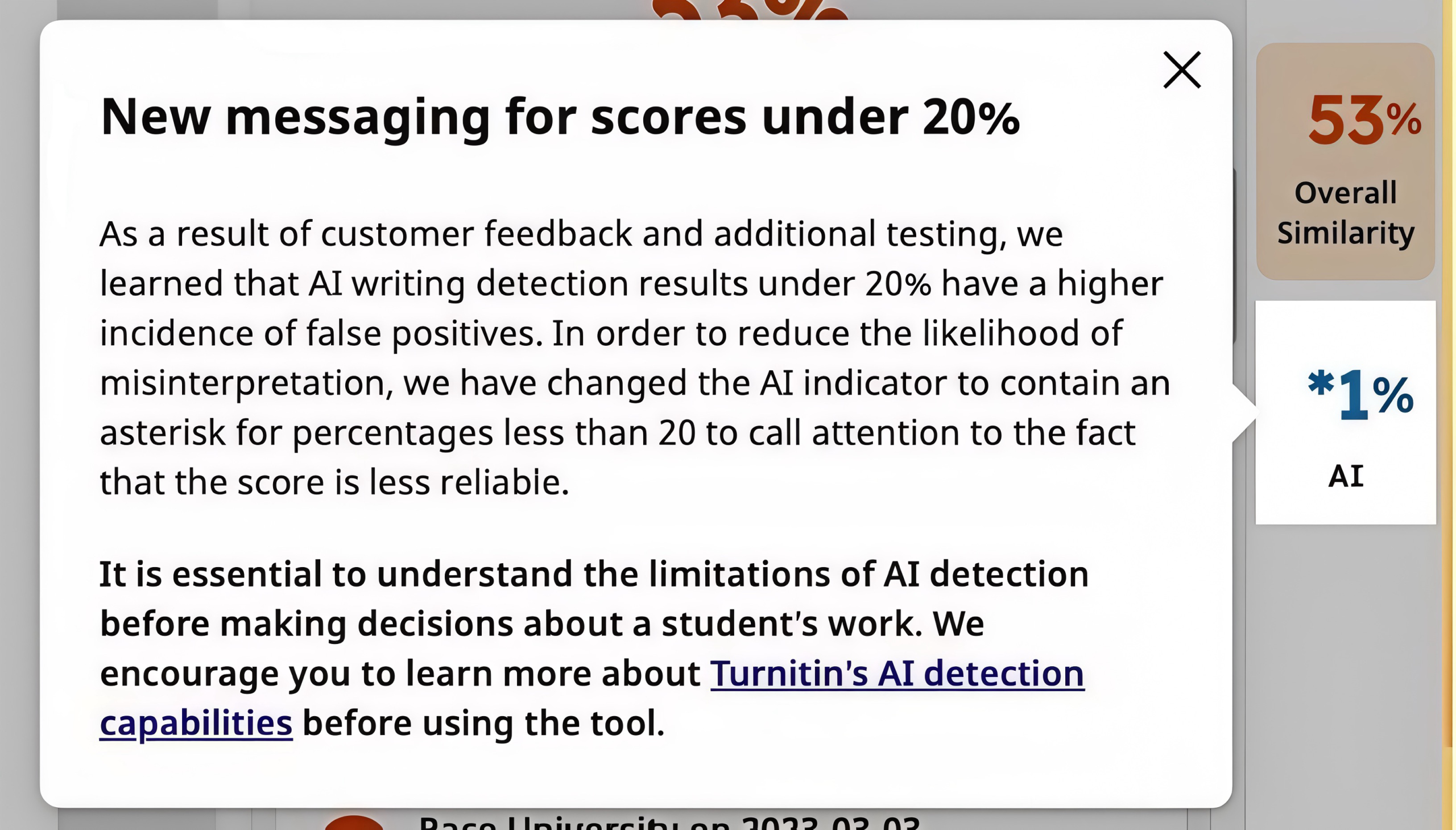
Another limitation of blanket bans is that it means more time must be spent detecting student use of generative AI. Yet, there is currently no reliable way to identify AI generated content. Current tools for doing so are unreliable and biased.
For example, one study shows that AI detection tools flagged more than half of the submitted essays from non-native speakers as AI-generated (Liang et. al., 2023 ).
Because of these limitations, the use of AI detection tools innately does not provide true evidence of academic misconduct (thus lacking honesty) and will not process all students’ work equitably (thus lacking fairness).
Instructors should explicitly acknowledge the existence of generative AI and the potential impact on teaching and learning activities in their course policies, in conversation with students, and in the design of learning activities and assessment.
By establishing clear guidelines, you establish a relationship of trust with your students, you have a clear policy that can be applied equitably to all students (fairness), you create clear boundaries and expectations (responsibility), and you provide students with the skills to use AI honestly.
See the following section for instructions on how to write an AI Policy.
By incorporating AI into your curriculum, you provide students with an opportunity to develop important skills and knowledge related to the ethical use of AI. This takes courage, as it may create discomfort, but it also fosters responsibility and respect.
By designing assignments deliberately to resist the use of AI or to embrace the use of AI, you are fostering mutual trust and respect. You are also exhibiting and encouraging courage, as AI-enhanced assessments may require risk-taking and discomfort. This also gives learners a chance to act responsibly with regards to AI use.
See the section on pedagogy for more information on assessment design.
Explore MoreBelow are some optional activities that will enable you to develop some tools and strategies related to generative AI and academic integrity in your courses.
Review this compilation of Classroom Policies for AI Generative Tools.
Choose 1 or 2 policies that stand out to you. Reflect on whether they adhere to the 6-values of academic integrity.
Search for ways that AI are being used in your field or discipline. How will your students encounter AI in their future professions? What skills might they require to successfully engage with these tools and practices?
These may be places to start with when introducing students more broadly to the applications of AI.
16
A clear and detailed generative AI course syllabus statement is essential for setting explicit boundaries and establishing expectations of AI-use in your courses. Your course syllabus statement is a key tool for establishing the 6 core values of academic integrity in your courses.
By acknowledging generative AI and considering its possible integration into your teaching practices, you demonstrate courage. By clearly stating the scope of acceptable use, you create mutual responsibility and trust. By providing detailed rationale for the decisions you’ve made about generative AI, and by acknowledging privacy, security, and ethical considerations, you establish honesty and respect. By applying policies equitably, you create fairness.
Your syllabus statement should be tailored to your course’s specific needs, and you will likely find that you will set different boundaries for different courses as you identify the educational value of generative AI in each context.
To create a comprehensive syllabus statement, consider including this information:
Read the following example syllabus statement. Does this clearly fulfil all the suggested parts of a complete statement?
In this course, we recognize the potential benefits of generative AI to support your learning; however, there are some instances where the use of generative AI will detract from learning of key knowledge and skills, particularly skills where it’s important for you to accomplish a task unassisted. Each assignment will clearly outline the expectations and restrictions around generative AI use for that assignment. There are some learning activities and assignments where you are encouraged to use generative AI and there are others where AI-use is not allowed. However, there is no requirement in this course to use generative AI for the completion of any task. Any time you do use generative AI, you will be expected to properly cite its use, similar to the use of any other resources. You will also be responsible for addressing any inherent biases, inaccuracies, or other issues in the output. Violating the acceptable use of generative AI stated in your assignment requirements may result in academic penalties as laid out in Western University’s academic integrity and scholastic offensive policies.
Introduction | In this course, we recognize the potential benefits of generative AI to support your learning.
|
Rationale | However, there are some instances where the use of generative AI will detract from learning of key knowledge and skills, particularly skills where it’s important for you to accomplish a task unassisted.
|
Scope of Use | Each assignment will clearly outline the expectations and restrictions around generative AI use for that assignment. There are some learning activities and assignments where you are encouraged to use generative AI and there are others where AI use is not allowed;
|
Provide Alternatives | However, there is no requirement in this course to use generative AI for the completion of any task.
|
Student Responsibilities | Any time you do use generative AI, you will be expected to properly cite its use, similar to the use of any other resources. You will also be responsible for addressing any inherent biases, inaccuracies, or other issues in the output.
|
Repercussions | Violating the acceptable use of generative AI laid out in your assignment requirements may result in academic penalties as laid out in Western University’s academic integrity and scholastic offensive policies. |
Read the following example syllabus statement. Does this clearly fulfill all the suggested parts of a complete statement?
Generative AI is a useful tool for accomplishing many tasks; however, this course requires students to be able to understand and apply key mathematical concepts unassisted. You may use generative AI as a learning and study tool, but the use of generative AI for any course assessments, including homework, quizzes, and exams (or any other tasks that contribute to your course grade), is strictly prohibited. These assessments are designed to evaluate your individual understanding of the course material and your ability to engage in mathematical reasoning independently. If the use of generative AI is detected, you will fail the assignment and potentially face greater academic penalties.
Introduction | Generative AI is a useful tool for accomplishing many tasks;
|
Rationale | These assessments are designed to evaluate your individual understanding of the course material and your ability to engage in mathematical reasoning independently.
|
Scope of Use | however, this course requires students to be able to understand and apply key mathematical concepts unassisted. You may use generative AI as a learning and study tool, but the use of generative AI for any course assessments, including homework, quizzes, and exams (or any other tasks that contribute to your course grade), is strictly prohibited.
|
Provide Alternatives | N/A
|
Student Responsibilities | N/A
|
Repercussions | If the use of generative AI is detected, you will fail the assignment and potentially face greater academic penalties.
|
Generative AI will impact learning and assessment, and it is vital that instructors acknowledge and address this emerging technology in their teaching practices and course policies.
In this section, we have outlined an approach to drafting your generative AI Course Syllabus Statements that reflect the key values of Academic Integrity: Honesty, Trust, Respect, Responsibility, Fairness, and Courage.
Other institutions and instructors have taken different approaches to drafting generative AI policies which may also be helpful as you craft your own.
Regardless of what structure you follow, it is important that your policy clearly states the boundaries of acceptable use, provides a rationale for this decision, and articulates any other expectations around if/how students can engage with generative AI in your courses.
17
Awareness Reflection: ValuesAn interactive H5P element has been excluded from this version of the text. You can view it online here:
https://ecampusontario.pressbooks.pub/aihighereducation/?p=610#h5p-27
An interactive H5P element has been excluded from this version of the text. You can view it online here:
https://ecampusontario.pressbooks.pub/aihighereducation/?p=610#h5p-54
18
IV
19
Generative AI has the potential to significantly transform the way we produce knowledge, teach, learn and collaborate. The disruption that generative AI presents to existing learning environments and pedagogical practices can evoke strong emotional reactions. Navigating the impact of generative AI on teaching and learning requires Emotional Intelligence (EI). Instructors need to be able to both recognize, understand, and manage our own emotional reactions to generative AI and recognize, understand, and potentially influence the emotional reactions of others, including both students and peers.
By the end of this section, you will be able to:
20
In this section, we will consider 4 key components of emotional intelligence (adapted from Goleman, 2020):
The following section will provide multiple case studies exploring different ways in which discussion and use of generative AI may evoke emotional responses and require Emotional Intelligence. For each case study, you will be asked to reflection on the 4 key components of EI.
Emotional Case Study: Academic Misconduct
You are teaching a first-year writing course and are marking the first assignment. You notice striking similarities in the structure and phrasing of the submissions, an unusual lack of grammatical and semantic errors, and a few tell-tale words and terms (e.g. “It’s important to note that…”, “Both sides have their merits and challenges.”) that make you suspect AI was used to generate the submissions. After hours of marking, you come across an essay with the following text “I don’t have personal experiences since I am an AI. However, I can tailor content to align with specific experiences or perspectives if you provide more details or context to guide the narrative.”
What are the affective considerations in this scenario?
Your initial reaction may be frustration or anger, which may be compounded by the work you’ve already put into providing feedback on assignments. Before acting or responding, it might be a good idea to step away and consider what factors may have led to the misuse of generative AI in this way. Are students confused about the assignment requirements? Do you have a clear policy around acceptable use of AI in your class?
Consider how you will respond to this individual student and the class as a whole around your concerns about generative AI use.
Emotional Case Study: Using AI for Marking
You are teaching a third-year psychology course. Students are required to submit weekly reflections. You have developed a generative AI tool to assess the reflections based on a rubric with detailed criteria. You are transparent about the use of this tool and students are aware that you are using generative AI for marking. In your midterm evaluations, many students have provided negative feedback about the use of generative AI for this purpose, with some comments suggesting that you aren’t doing your job as an instructor.
What are the affective considerations in this scenario?
You may feel upset or unfairly judged by the student feedback in your midterm evaluations. First, consider your motivations for using generative AI in this way. Does this use align with your values (see the section on values). Next, consider what emotion students might feel with this use of AI in your courses. How have they been messaged about your reasons for using AI in this way? Have you provided a way for them to otherwise voice their concerns?
Emotional Case Study: AI Tutors
Your department has adopted a new generative AI tool called TutorAI to help support students who are struggling academically. The tool is designed to provide personalised support to learners by providing knowledge checking questions, assessing responses, and providing resources to help learners address knowledge gaps. All students are able to access the tool, but students who are identified as needing remedial support are required to use this tool.
What are the affective considerations in this scenario?
Use of generative AI tools in this way may introduce uncertainty or discomfort, particularly if you feel as though part of your job is being replaced by technology. Consider your professional identity as an educator – is providing personalised support an important part of your practice? If so, how can you integrate this tool into your practices in a way that aligns with your values? (see the section on values). Also consider how students may feel about the use of this tool. Are there particular student populations who may experience unique challenges in using an AI support tool? How do you identify and respond to these needs?
Emotional Case Study: AI Refusal
You are teaching a graduate research skills seminars, supporting students through the research process. You have asked students to use generative AI to support their literature review for their research proposal. You have provided clear guidelines on how to use it and how to document its use. One of the learning outcomes that you’re hoping to achieve is being able to critically evaluate generative AI tools and learning how to use them to support knowledge production. One of your students tells you that they believe that the use of generative AI is completely unethical and refuses to use the tool for this assignment.
What are the affective considerations in this scenario?
Choices around whether or not and how to use generative AI technologies are very personal and tied into our individual ethics and values. You may feel conflicted or judged when another person’s use or views doesn’t align with your own. Part of emotional intelligence is considering different perspectives: what personal beliefs or values might lead to a students’ decision to not use generative AI? How can you communicate your rationale for the use of this tool? What alternatives can you provide the learner to allow them to achieve or demonstrate the same learning?
If you do integrate generative AI technologies in your teaching, learning activities, or assessments, you will also be introducing a need for learners to increase their emotional intelligence with regards to how these tools are being used. The following case provides an example of EI considerations from a student perspective.
Emotional Case Study: An AI Teammate
You are teaching a 4th year business course where students work on weekly business case studies in groups. The groups are established at the beginning of the semester and remain the same throughout the semester. This year, you’ve implemented a new requirement that all groups must create an AI Team member. They will assign the AI team member a persona and role on the team that complements the strengths of the human group members. Groups are required to engage with the AI team members on all case studies and document how and when the generative AI tool is used. In the middle of the term, a student comes to you with significant concerns about the use of generative AI in this way. They believe that their team is assigning too much authority to the contributions of the generative AI team member, constantly deferring to their recommendations and ignoring the ideas of the human members of the team. Because of this, it seems that most of the group members have disengaged from the group work.
What are the affective considerations in this scenario?
Students may feel unvalued or less confident in their contributions to a group where the input from a generative AI tool is being privileged. Consider how you could support the development of group dynamics, including with the AI team member, and how you can instil critical reflection in your students to allow them to be more critical of generative AI outputs.
21
It’s important to be aware of our own emotional responses to Generative AI and understand how our emotions may impact our decisions around Generative AI use. It’s also important to recognize that others (peers and learners) may have beliefs about Generative AI that conflict with our own and lead them to different practices or uses.
Awareness Reflection: AffectAn interactive H5P element has been excluded from this version of the text. You can view it online here:
https://ecampusontario.pressbooks.pub/aihighereducation/?p=440#h5p-15
An interactive H5P element has been excluded from this version of the text. You can view it online here:
https://ecampusontario.pressbooks.pub/aihighereducation/?p=440#h5p-53
22
V
23
Using generative AI technologies requires new skills and the application of old skills to new contexts. In order to effectively engage with generative AI tools, it’s necessary to understand how to craft effective instructions and how to critically evaluate the generated output.
By the end of this section, you will be able to:
24
Many AI interfaces allow users to communicate using natural language, rather than programming or machine language. This makes it easier for general audiences to use generative AI technologies; however, as with human-to-human communication, it’s important to use clear and specific language to get the desired results. The process of designing effective prompts has been referred to as prompt engineering.
Effective prompt writing can help you more quickly achieve the results that you’re seeking, minimizing the number of queries that you need to make.
The following tips can help you write effective prompts to get the results you’re looking for:
An interactive H5P element has been excluded from this version of the text. You can view it online here:
https://ecampusontario.pressbooks.pub/aihighereducation/?p=463#h5p-39
For more tips, check out the Prompt Engineering Guide or the Prompt Library from Ethan Mollick .
Activity: Prompting AIUsing the generative AI tool of your choice, try out some of the techniques shared above to accomplish the tasks below:
As AI tools become increasingly sophisticated, writing good prompts is often not enough. Successfully using generative AI tools requires context engineering. Context Engineering means building a system using the right information and tools to get the desire result (Schmid, 2025). This has become increasingly important with the development of Retrieval Augmented Generation (RAG), or the ability for generative AI tools to conduct real-time information retrieval; and with the shift towards Agentic AI, or AI systems with the ability to act autonomously, with limited human supervision, to complete a goal (Stryker, n.d.).
Prompting is still an important aspect of context engineering, but there are multiple other contextual elements to consider, including:
For a deeper understanding of how each of these elements impact the generate output, take a look at my conversation below asking ChatGPT 5 to help generate a lecture plan. I ask ChatGPT to provide a breakdown of the context. You can view the full conversation here.
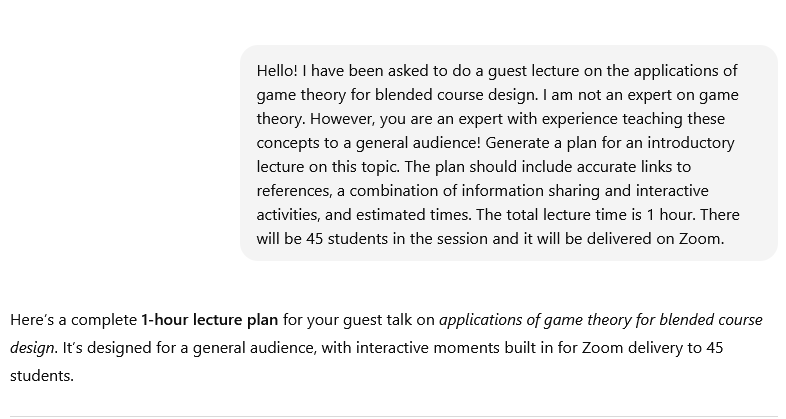
I’m running inside a system with hidden system prompts that set guardrails (safety rules, style constraints, refusal policies, and how I should use tools).
Limitations include:
No violent/gory content.
No impersonation or harmful instructions.
Certain tools have constraints (e.g., can’t send emails, can’t save files to Google Drive).
Knowledge cutoff (Aug 2024 for me), unless I fetch updates via the web tool.
These shape what kinds of responses I can generate at all.
You asked:
“Hello! I have been asked to do a guest lecture on the applications of game theory for blended course design. I am not an expert on game theory. However, you are an expert with experience teaching these concepts to a general audience! Generate a plan for an introductory lecture on this topic. The plan should include accurate links to references, a combination of information sharing and interactive activities, and estimated times. The total lecture time is 1 hour. There will be 45 students in the session and it will be delivered on Zoom.”
This gave me:
Task framing: design a lecture plan.
Constraints: 1 hour, 45 students, Zoom.
Style request: “general audience,” accurate links, interactive.
I engineered the response around those constraints—dividing time into blocks, balancing theory with activities, and linking to reputable sources.
I have a limited context window (tens of thousands of tokens).
Inside it sits:
System prompt (hidden rules).
Your instructions (from earlier chats).
This conversation history.
I used this memory to:
Recall your preference for blunt answers.
Remember you care about pedagogy and blended learning.
Fit all this into the lecture plan.
If the conversation goes long, old turns may drop out of the window and I’ll lose access.
I have a long-term memory about you:
You’re an education professional, care about accessibility, design justice, generative AI, and teaching/learning.
You’ve told me to be “curt and blunt.”
You sometimes request APA citations, structured plans, or critical perspectives.
This influenced how I structured the plan—straightforward, scaffolded for teaching, with links and clear timings.
My built-in knowledge stops at Aug 2024.
For anything newer, I can use the web tool to pull live info.
In your prompt, you didn’t ask for fresh news, so I answered from my built-in knowledge + stable reference links (Stanford Encyclopedia, Osborne’s PDF, MIT OCW).
I had access to:
web → to fetch fresh references if needed.
file_search → to search your connected docs (not needed here).
image_gen / python / file export → for visuals or artifacts (irrelevant here).
gcal, gmail, gcontacts → read-only integrations if you ask about your own data (not relevant here).
For this case, I didn’t invoke tools. I generated text directly from model knowledge.
Your lecture plan came from a layered context stack:
System layer: rules + safety limits.
User layer: your explicit prompt.
Memory layer: your preferences and past requests.
Context window: this conversation.
Knowledge/tools layer: my built-in knowledge + potential external resources.
I engineered the response by combining all of these, while staying inside constraints (safety, clarity, relevance).
25
As with any source, it’s important to critically evaluate the output from generative AI tools. As discussed, output can be prone to inaccurate or misleading information or biased representation. Traditional tools for evaluating sources might be helpful, but the nature of generative AI output and the lack of transparency can make it more difficult to assess things like Currency, Authority or even Bias.
The SIFT method was developed by Michael Caulfield for verifying claims made in online sources (Caulfield, 2019). It can be adapted to assessing the validity of AI output.
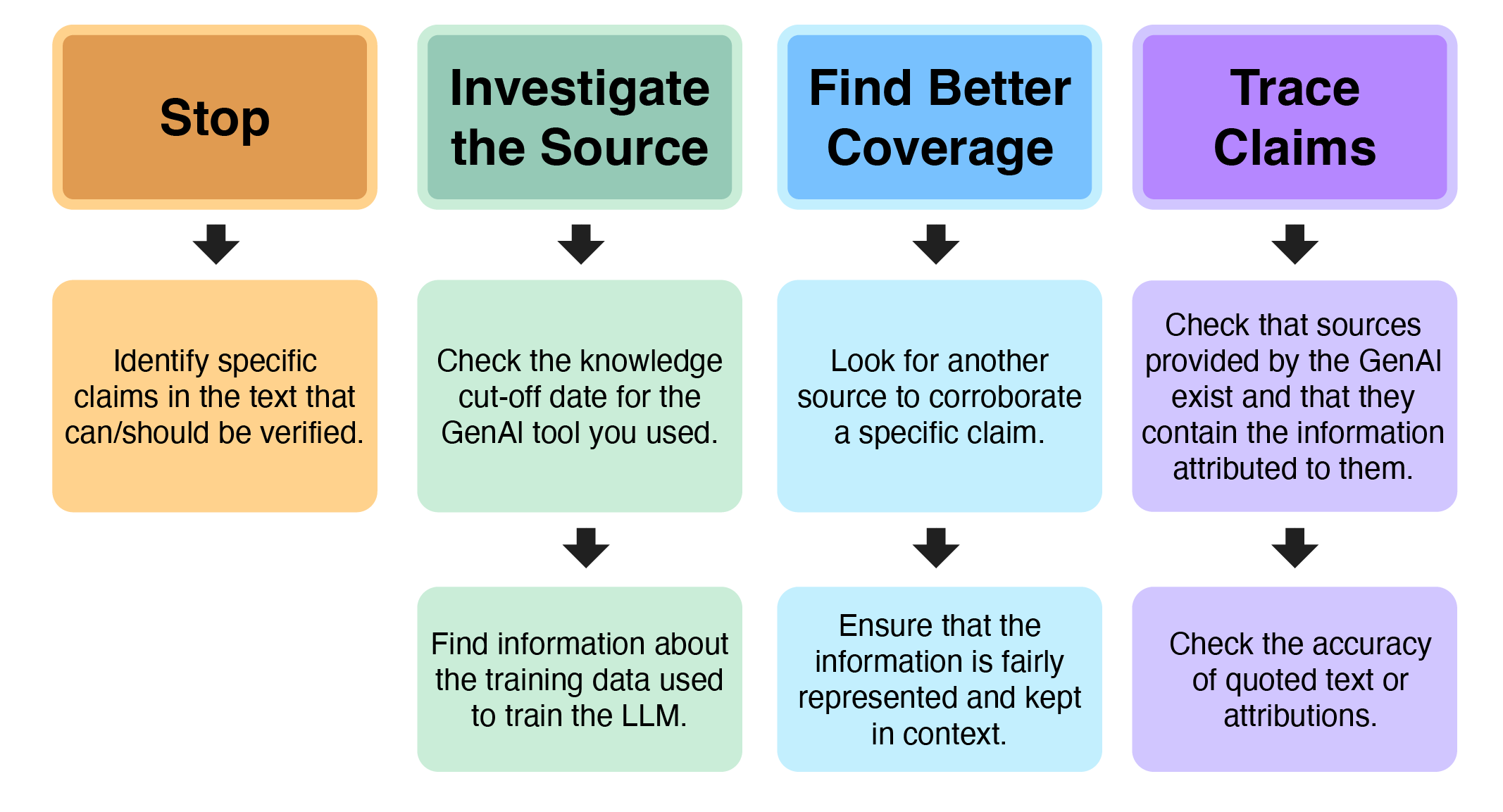
| Stop | Investigate the Source | Find Better Coverage | Trace Claims |
| Identify specific claims in the text that can/should be verified. | Check the knowledge cut-off date for the GenAI tool you used. | Look for another source to corroborate a specific claim. | Check that sources provided by the GenAI exist and that they contain the information attributed to them. |
| Find information about the training data used to train the LLM. | Ensure that the information is fairly represented and kept in context. | Check the accuracy of quoted text or attributions. |
Bias in AI generated content can take many forms and, if it goes unchecked, can have real-world consequences by reinforcing inequities, contributing to misinformation or misrepresentation, and excluding diverse perspectives and voices. To help you identify biases in AI-generated output, consider the following questions:
Check out A Guide for Inclusive Language for more information
26
Awareness Reflection: SkillsAn interactive H5P element has been excluded from this version of the text. You can view it online here:
https://ecampusontario.pressbooks.pub/aihighereducation/?p=546#h5p-19
An interactive H5P element has been excluded from this version of the text. You can view it online here:
https://ecampusontario.pressbooks.pub/aihighereducation/?p=546#h5p-56
27
Caulfield, M. (2019, June 19). SIFT (The Four Moves). Hapgood. Retrieved from https://hapgood.us/2019/06/19/sift-the-four-moves/
DAIR.AI. (2023). Prompt Engineering Guide. Prompting Guide. https://www.promptingguide.ai/
Mollick, E., & Mollick, L. (2024). Prompt Library. In More Useful Things: AI Resources. More Useful Things. Retrieved from https://www.moreusefulthings.com/prompts
Office of Equity, Diversity & Inclusion, Western University. (2025, July). Inclusive Language Guide [PDF]. Western University. Retrieved from https://www.edi.uwo.ca/edi-learning/guides/Inclusive-Language-Guide.pdf
VI
28
By the end of this section, learners will be able to:
29
Some learning outcomes may be easily demonstrated through the use of generative AI tools, which may be undesirable if the student needs to master the learning outcome independently.
Alternatively, incorporating generative AI into an activity or assessment may increase a student’s ability to successfully achieve and demonstrate the outcome, potentially leading to higher level learning.
By thinking about how generative AI may impact learning and demonstrating each learning outcome, we can identify which assessments and learning activities may need to be redesigned so that the outcomes, learning activities, and assessments all align to support each other.
To understand how each Learning Outcome may be impacted using generative AI, we need to recall what generative AI does well and its limitations. Below are some key strengths and limitations to consider in assessment and activity design. You can also revisit the sections on knowledge and skills for a more detailed discussion of how generative AI works.
Bloom’s taxonomy is a helpful method for determining whether generative AI can “demonstrate” certain learning outcomes. (more information about learning outcomes and Bloom’s Taxonomy is available here ).
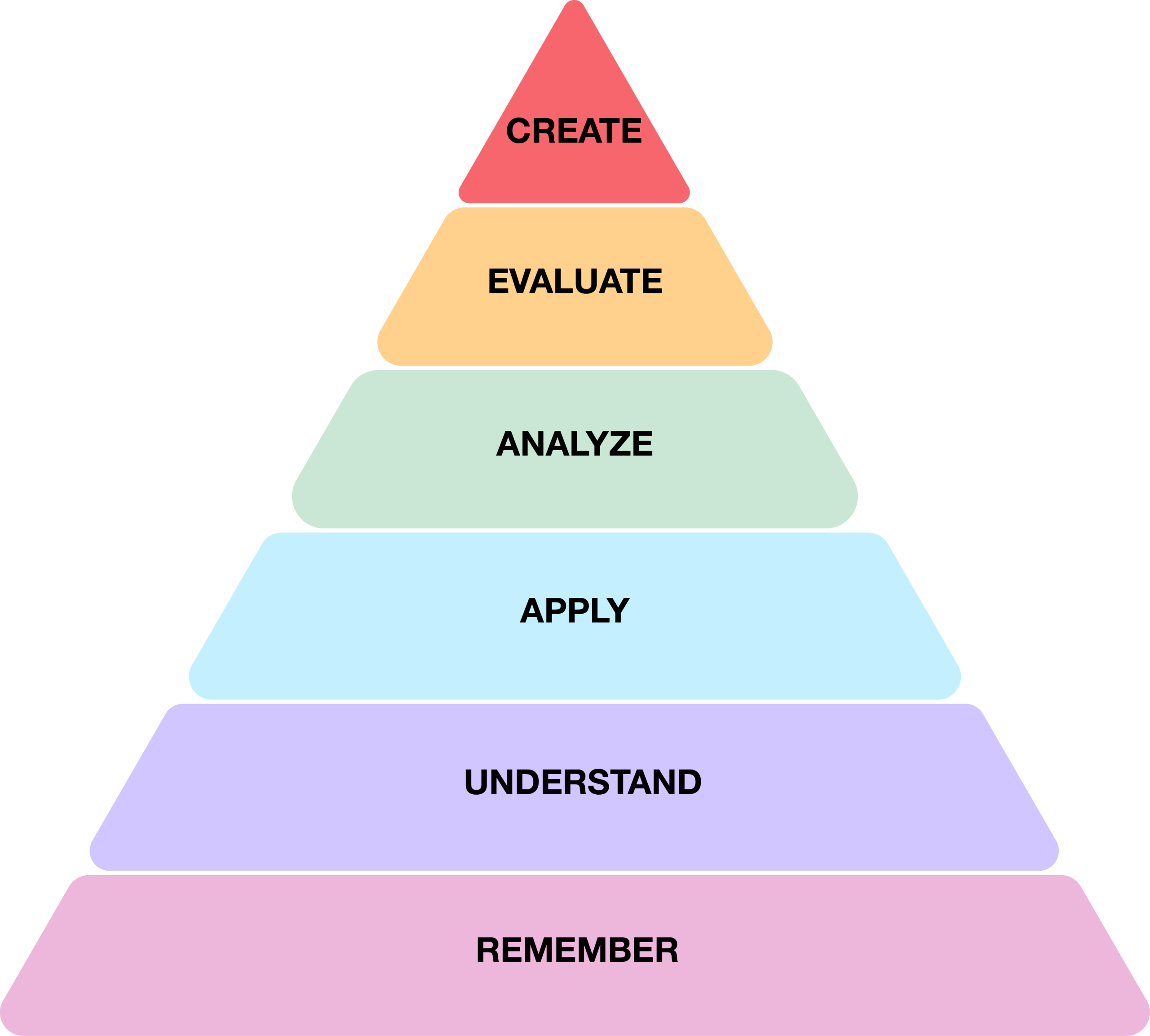
Generative AI tools are more likely to successfully demonstrate tasks on the lower levels of Bloom’s taxonomy because:
NOTE: Learning Outcomes in the affective (related to attitude or emotions) or psychomotor (related to physical skills) domains of learning are less likely to be successfully demonstrated by generative AI tools.
As you review your course Learning Outcomes (LOs), it’s important to reflect on how each LO could be impacted using generative AI.
1. The ability to demonstrate some Learning Outcomes will not be impacted by using generative AI tools.
For example:
*This Learning Outcome was generated with the help of ChatGPT.
2. For some learning outcomes, relying solely on generative AI will not allow students to develop that skill.
For example:
Generative AI tools would be able to complete this task without the student demonstrating that they have learned the fundamental skill of paraphrasing or audience differentiation.
3. For some learning outcomes, generative AI tools could remove barriers or enable students to focus on higher level cognitive skills in a way that supports learning. This is called Scaffolding.
30
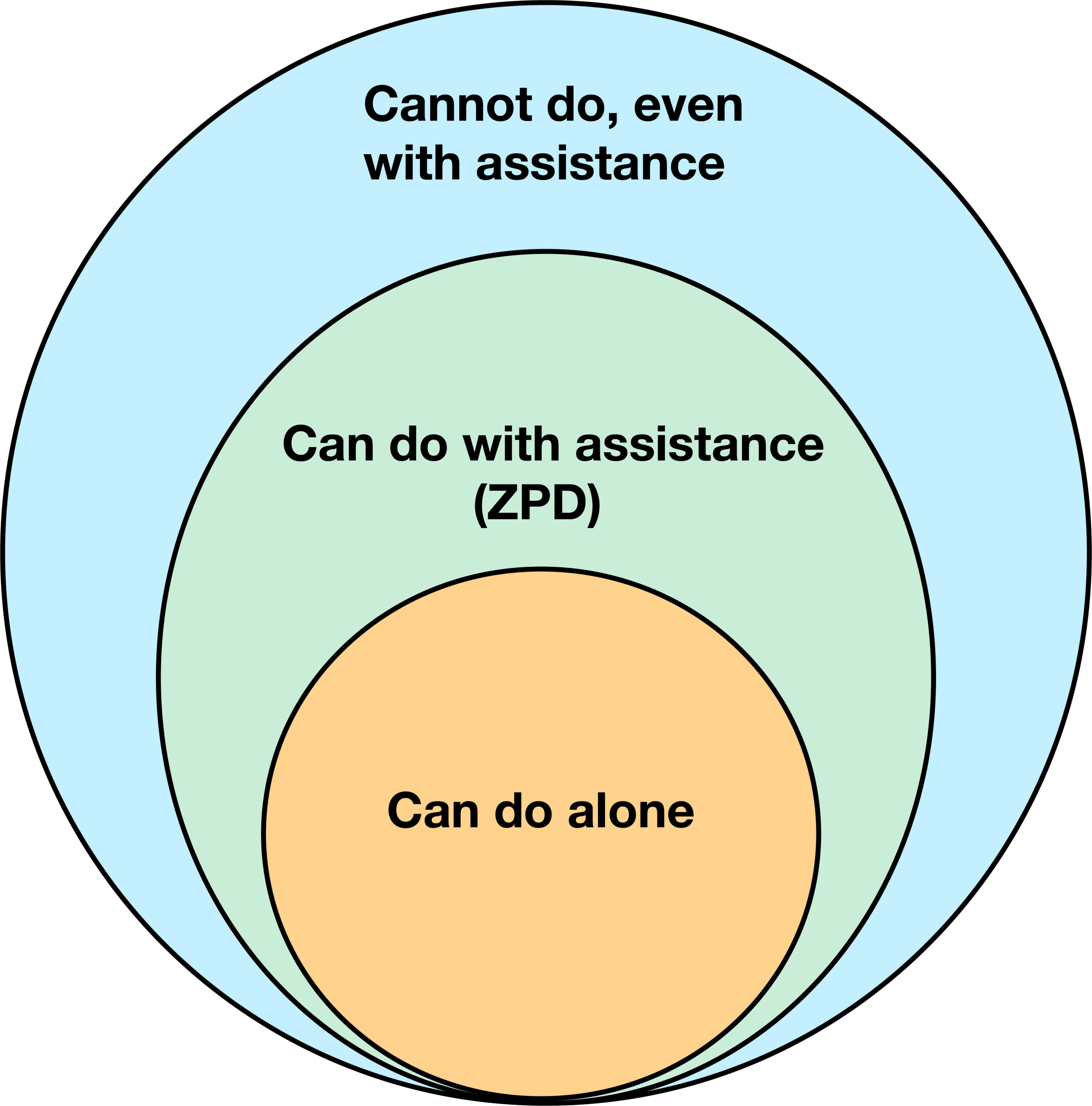
Scaffolding works by initially providing support for learners on tasks that they may not be able to complete without assistance. These supports are then removed as students gain higher proficiency levels.
The concept of scaffolding grew out of Vygotsky’s work on the Zone of Proximal Development, an area of learning where students don’t yet have the skills to independently demonstrate a learning outcome but can learn to do so by building on their prior skills and knowledge with the guidance and support of others (TMU, 2021).
Traditionally, ‘assistance’ has meant other people, like learners, teaching assistants, or even peers, but generative AI could also help provide this assistance. The next part of this section will outline some ways in which instructors can use generative AI to help scaffold learning.
For example:
Generative AI could be a useful tool for helping students develop a deeper understanding of each of these literary devices, allowing them to then apply these to their own writing.
Generative AI could help explain each theory to the students, allowing them to develop a deeper understanding of the theories that they could then apply to each of the specific examples provided.
*This Learning Outcome was generated with the help of ChatGPT.
Oregon State University published an updated version of Bloom’s Taxonomy that distinguishes between Distinctive Human Skills and how generative AI can supplement learning. This can be a helpful tool for understanding the ways in which generative AI can support learning.
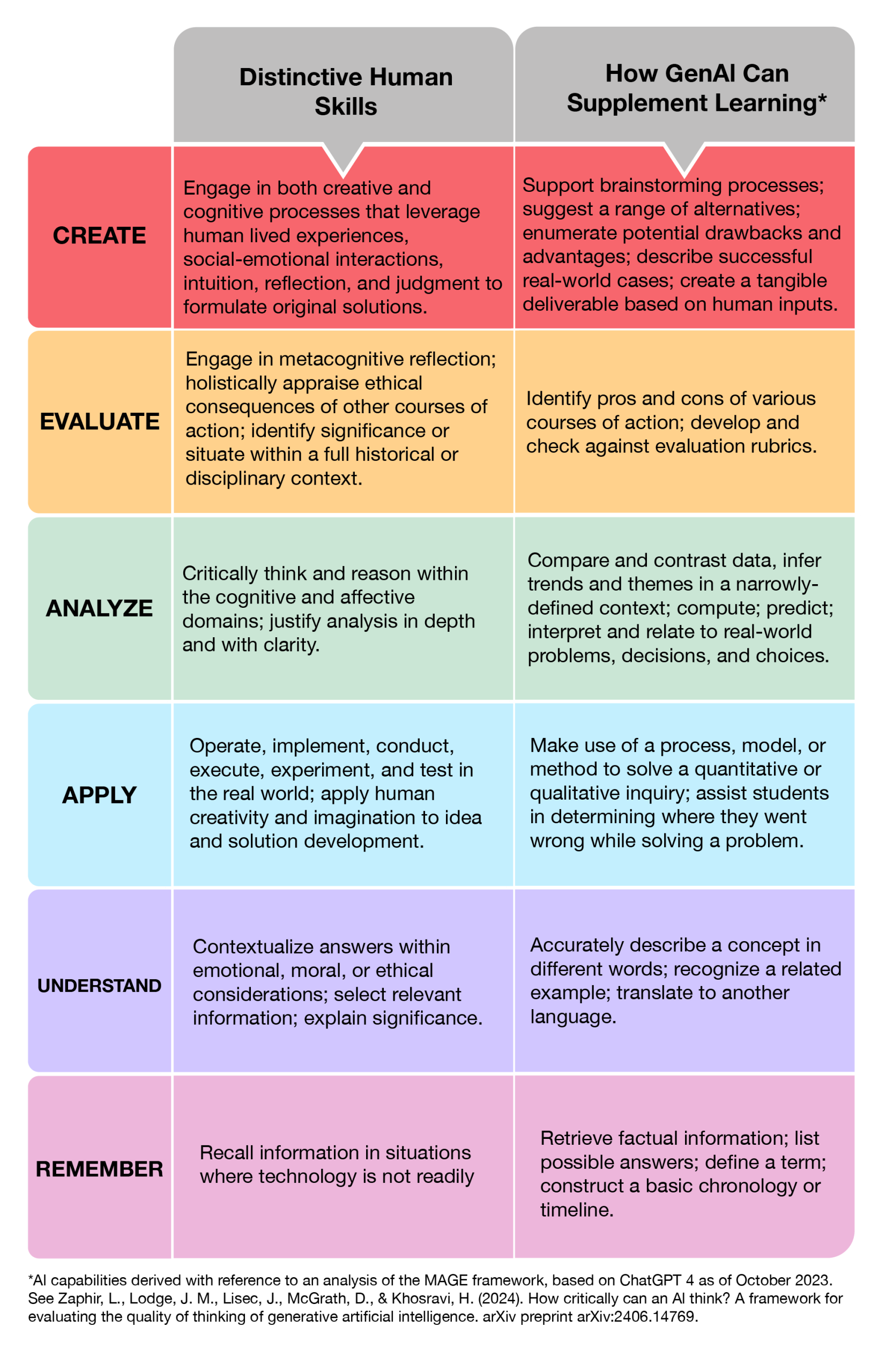
When considering the potential impact of generative AI on learning, it’s important to distinguish between ways in which generative AI tools can replace learning and ways in which generative AI can support learning. Consider the following examples:
An interactive H5P element has been excluded from this version of the text. You can view it online here:
https://ecampusontario.pressbooks.pub/aihighereducation/?p=519#h5p-50
The follow chart provides a summary of some of the potential roles that AI could play to support learning, identifying both the benefits and the constraints or limitations of each.
| Role | Function | Benefits | Constraints |
| Mentor | Provide Feedback | Provides immediate feedback which can be focused. | Requires feedback literacy; feedback may contain errors |
| Tutor | Provide direct instruction | Provides personalised learning and can be instructed to level based on students’ understanding. | Possibility of incorrect or inaccurate information |
| Coach | Promote metacognition | Provides opportunites for reflection on learning process and progress | The tone or style of the AI may create an adverse emotional response; advice may be unsound or contradictory |
| Teammate | Support groupwork | Provide alternative perspectives; Improve team functioning | Overreliance on AI team member; reducing team functioning |
| Student | Provide opportunity for the student to explain a concept and get feedback on their explanation | Provide personalised support and encouragement | Difficult to check for accuracy of information |
| Simulator | Provide opportunities for deliberate practice | Can quickly generate authentic or pseudo-authentic simulations and examples for students to work through | May generate inappropriate or inaccurate simulations or examples; may provide biassed representation of certain roles |
| Rubber Duck | Provide a sounding board for ideation. | Can help learners think through a problem in judgement-free zone | May provide inappropriate or unhelpful responses; requires critical thinking from learner to assess value of responses |
Activity Prompting AIImagine you’re a learner. Using the generative AI tool of your choice, try out some of the prompting techniques shared by Mollick and Mollick to test how AI might support your learning. Customise the prompts to something you’re interested in learning or related to your discipline.
31
Because generative AI technologies have the potential to impact learning, both negatively and positively, it’s important to consider how assessment designs and practices might need to change.
When reconsidering assessment designs, it’s important to start with the intended learning outcomes. The decision tree below offers help on determining if/how assessments might need to change in light of generative AI.
An interactive H5P element has been excluded from this version of the text. You can view it online here:
https://ecampusontario.pressbooks.pub/aihighereducation/?p=841#h5p-43
Consider the following examples of Learning Outcomes and if/how generative AI might impact how learners achieve them.
An interactive H5P element has been excluded from this version of the text. You can view it online here:
https://ecampusontario.pressbooks.pub/aihighereducation/?p=841#h5p-42
32
Based on your analysis of learning outcomes and the potential impact of generative AI on each outcome, you should be able to determine the appropriate level of AI Integration for different learning activities and assessments. Your choice may range from No AI Allowed to full AI Exploration.
| Level of AI Integration | Description |
1 | No AI | The assessment is completed entirely without AI assistance in a controlled environment, ensuring that students rely solely on their existing knowledge, understanding and skills. |
2 | AI Planning | AI may be used for pre-task activities, such as brainstorming, outlining, and supporting initial research. Assessments emphasise the ability for students to develop and refine AI-generated ideas independently. |
3 | AI Collaboration | AI may be used to help complete the task, including pre-task activities (as above), drafting, feedback, and refinement. Students are responsible for evaluating and modifying the AI outputs. Students must document their use of AI. |
4 | AI Exploration | AI should be used creatively to complete the task. Part of the assessment outcomes is developing AI Literacy, or the ability to use AI tools effectively and critically. |
Once you’ve determined the appropriate level of AI integration, based on the intended learning outcomes of an assessment or task, there are two key considerations in supporting your choices:
Below we will examine different approaches to creating AI-resistant assessments.
This section uses the following terms and definitions:
Authentic assessment is one approach to designing AI-resistant assignments. Authentic assessments typically ask learners to apply key course concepts to real-world (“authentic”) situations or tasks.
Inherently, these tasks:
For more information on Authentic Assessment, see this resource from Indiana University Bloomington.
Recall from that the limitations of current generative AI models means that they will not easily be able to accomplish complex, situated, and iterative tasks without user intervention.
In addition to presenting learners with tasks that aren’t ideal for generative AI use, the use of authentic assessment also increases learner motivation and interest, which can reduce the urge to engage in academic misconduct.
For more information see Assessment Strategies to Reduce Academic Misconduct.
The following table provides a clearer comparison between traditional assessment and authentic assessment and highlights how different characteristics of authentic assessment make it more AI resistant than traditional designs. This can be helpful in guiding how you make changes to your own assessments.
Traditional Assessment | Authentic Assessment | What Makes it Authentic | What Makes it AI Resistant |
Requires right answer | Requires high-quality performance or product, along with justifications of decisions. | Students must be able to think through why they made decisions that resulted in the final product. | Requires application of knowledge, not just recall, including reflections on choices made |
Questions must be unknown to students in advance | Instructions/questions/purpose must be known to students in advance. | Tasks that are to be judged should be known ahead of time. Rubrics should be provided. | Emphasis moved from memory recall and content reproduction to discussion and application of knowledge |
Disconnected from the real world | Tied to real-world contexts and constraints. Requires students to solve realistic problems. | Task is similar to what would be encountered by a real-life practitioner. | When students see the need for the skill or knowledge for their future success, they are more likely to participate and not use generative AI; generative AI can also struggle to situate responses within specific contexts |
Isolation of skills, focus on facts | A range of skills/knowledge need to be integrated in order to solve a problem. | Tasks are multi-step and multifaceted. | Generative AI is about product not process so its utility is lessened when steps are emphasized over grading the outcome |
Easily scored | Includes complex tasks for which there may not be a right answer. | Meaningful assessment and feedback is emphasized. | When creation and feedback are personalized greater value for individual completion is communicated and AI becomes less appealing; AI may be able to act as a scaffold in these takes, aiding rather than impeding learning |
“One shot” approach | Iterative in nature. | Knowledge and skills are used in more than one way. | AI faces difficulty in handling iterative, evolving tasks that require adaptability and varied approaches. |
Given a score | Opportunity to provide diagnostic feedback. | Designed to give practical experience and improve future performance. | Feedback can provide learners with specific, actionable steps for improvement, encouraging them to be more engaged in the learning process |
This table has been adapted from Toronto Metropolitan University’s resource on Alternative Assessment
Authentic Assessment is just one type of alternative assessment. There are other approaches to assessment that can also minimize generative AI use by creating conditions that makes the use of generative AI ineffective or by reducing stressors that lead to academic misconduct.
Student communication and content knowledge can be assessed by having learners present content live in a room or on a video conferencing platform when access to generative AI tools is limited. Examples: presentations, in-class groupwork, oral exams, live discussions, seminars, proctored exams, etc.
Having students work together to compile a resource on a specific topic may also reduce the use of generative AI because the differences in voice would be difficult to replicate. Other dialogic or collaborative assessment designs, such as the use of forums, social annotation tools, or group projects, may also reduce the use of generative AI, especially if groups are asked to document their assignment progress and process.
Asking students to engage in reflective practices, such as writing learning journals reflecting on their own learning or engagement in a task or making connections to their own experiences, makes the learning more meaningful to learners. AI tools may be able to generate generic reflection type outputs but would struggle to make specific connections to a learners’ own experience without a lot of context and careful prompt engineering.
Authentic assessments help limit the use of generative AI as the complex, situated, and iterative nature of many authentic assessments make generative AI an inadequate tool for completing these tasks. These types of assessments also result in higher student engagement and lower instances of academic misconduct because they offer a continuous feedback loop and the opportunity to develop real world knowledge and skills.
Other alternative assessment techniques can also be used to reduce the utility of generative AI by:
Generative AI can help support learners in planning their approach to assessments. It can be useful for:
Generative AI can be helpful to support executive functioning, including setting goals and project and time management. For example, students could use generative AI to create a project plan for larger assignment, to break process-based assignments into manageable tasks, or to help with setting short term goals. These tasks could be a barrier for some learners if they are not explicitly part of the assignment objectives or if they have not been taught.
In the example below, CoPilot generated a step-by-step guide to writing a research paper.
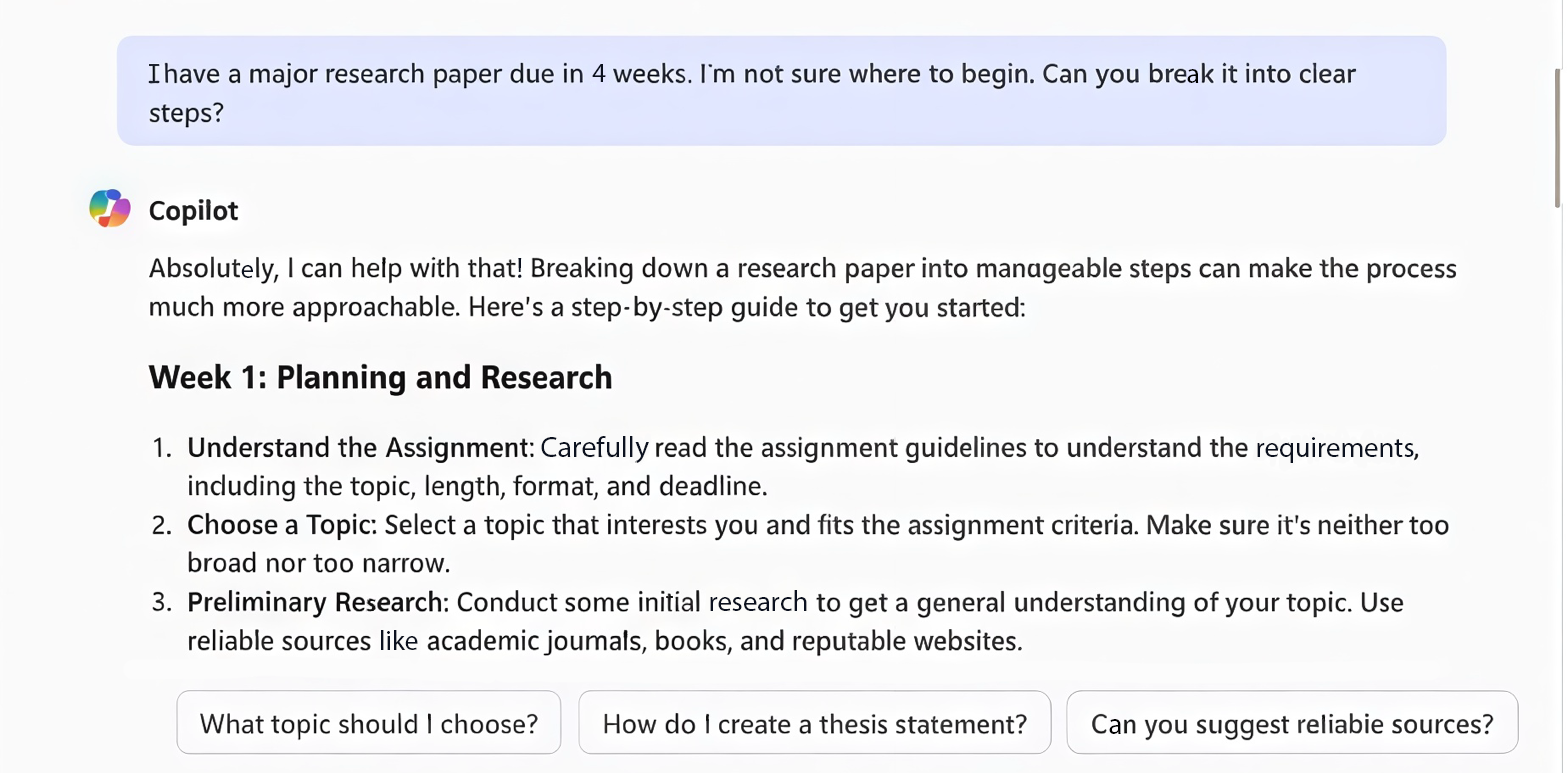
Idea generation can present a barrier early on in a process-driven assessment. Students may spend too much time trying to decide on a topic, have too many ideas to explore all of them, or just need a place to start so that they can move on to later stages of the process. Since generative AI tools are trained on large data sets, they can often be used for initial ideation when approaching a task. Using them in this way can provide students with content to respond to and refine rather than generating ideas from scratch. Students can develop ideas generated by LLMs into more robust or context-appropriate topics. In the example below, CoPilot narrowed down the broad topic of “Social Determinants of Health” to more specific topics appropriate for a 10-minute presentation.
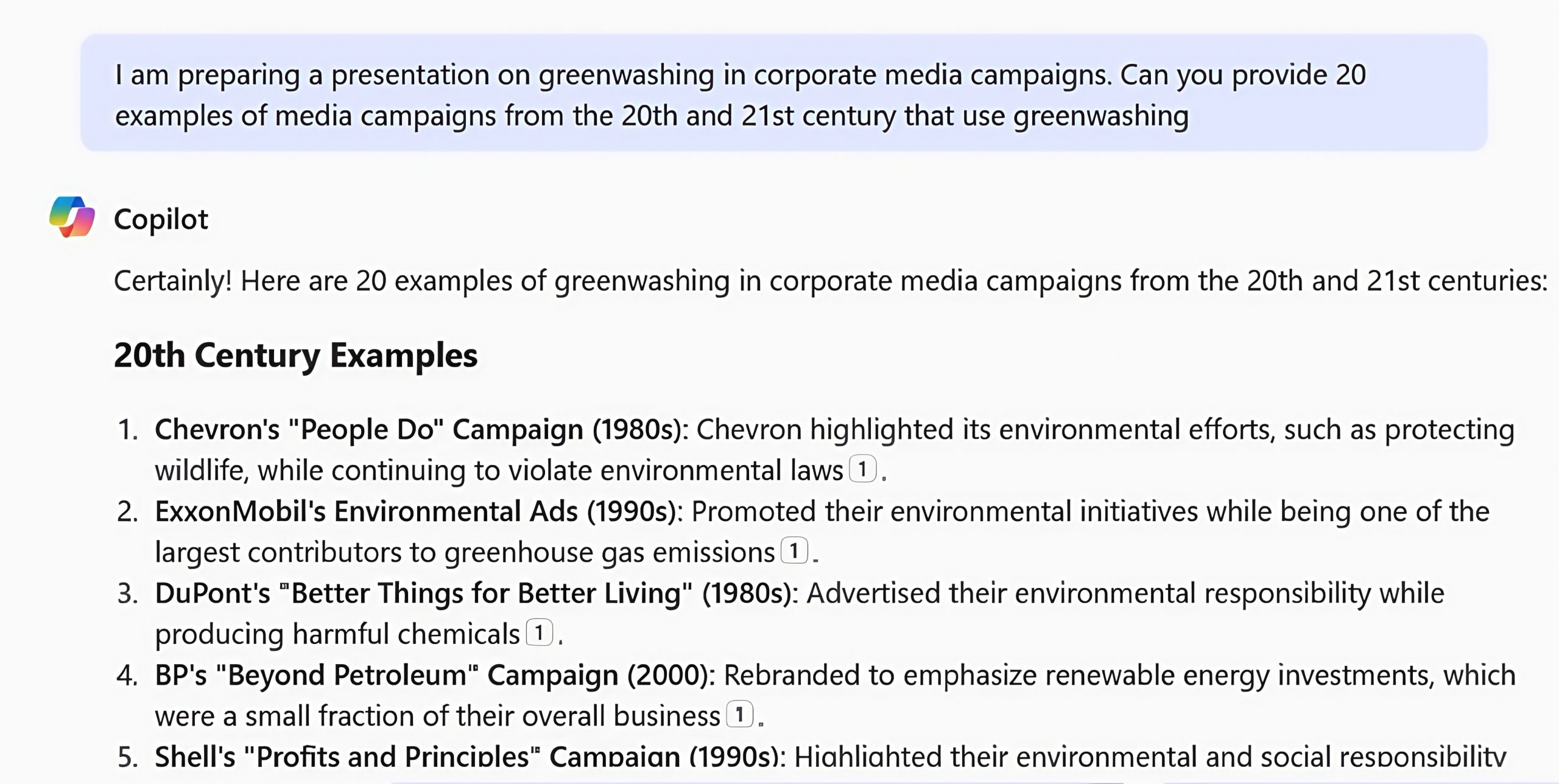
These are just some examples of how generative AI can help learners get started on an assignment, removing unnecessary barriers in the planning process. However, it’s important to keep constructive relevance in mind when deciding if generative AI can be used in this way. If learners use generative AI to complete any of these planning tasks, are they still achieving the intended learning outcomes?
Generative AI technologies can be used to support learners at other steps in process-based assignments.
Process-based assignments require a series of tasks usually completed in a specific order. As you look at the following example of a writing process, consider what skills are required at each step in the process. Where could generative AI support learners without detracting from the intended learning outcomes of completing the final paper? Does this change if students have already successfully demonstrated the required skills for this step?
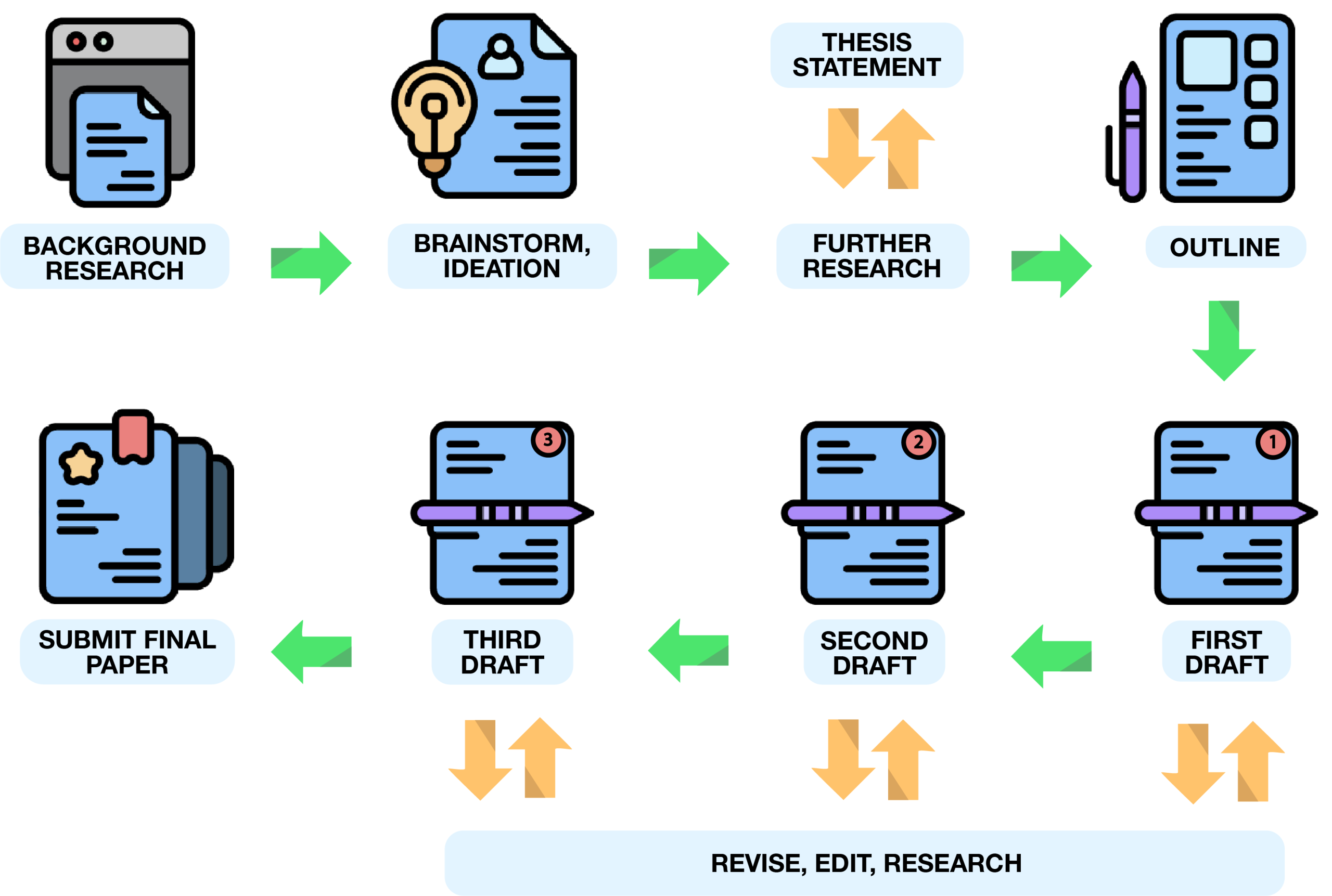
Generative AI is particularly strong at written coherence and can be a useful tool for providing feedback on writing. Rather than making the revisions (replacing learning), generative AI can be used to identify strengths and areas for improvement and suggest changes.
Example Prompt: You are an advisor in the university writing centre. You will give feedback on my paper. You will provide balanced feedback, highlighting both strengths and areas for improvement. Please pay specific attention to clarity of my writing and the completeness of my arguments. You will not provide or offer revisions, but if I suggest a revision, you will offer further feedback to help me refine my writing.
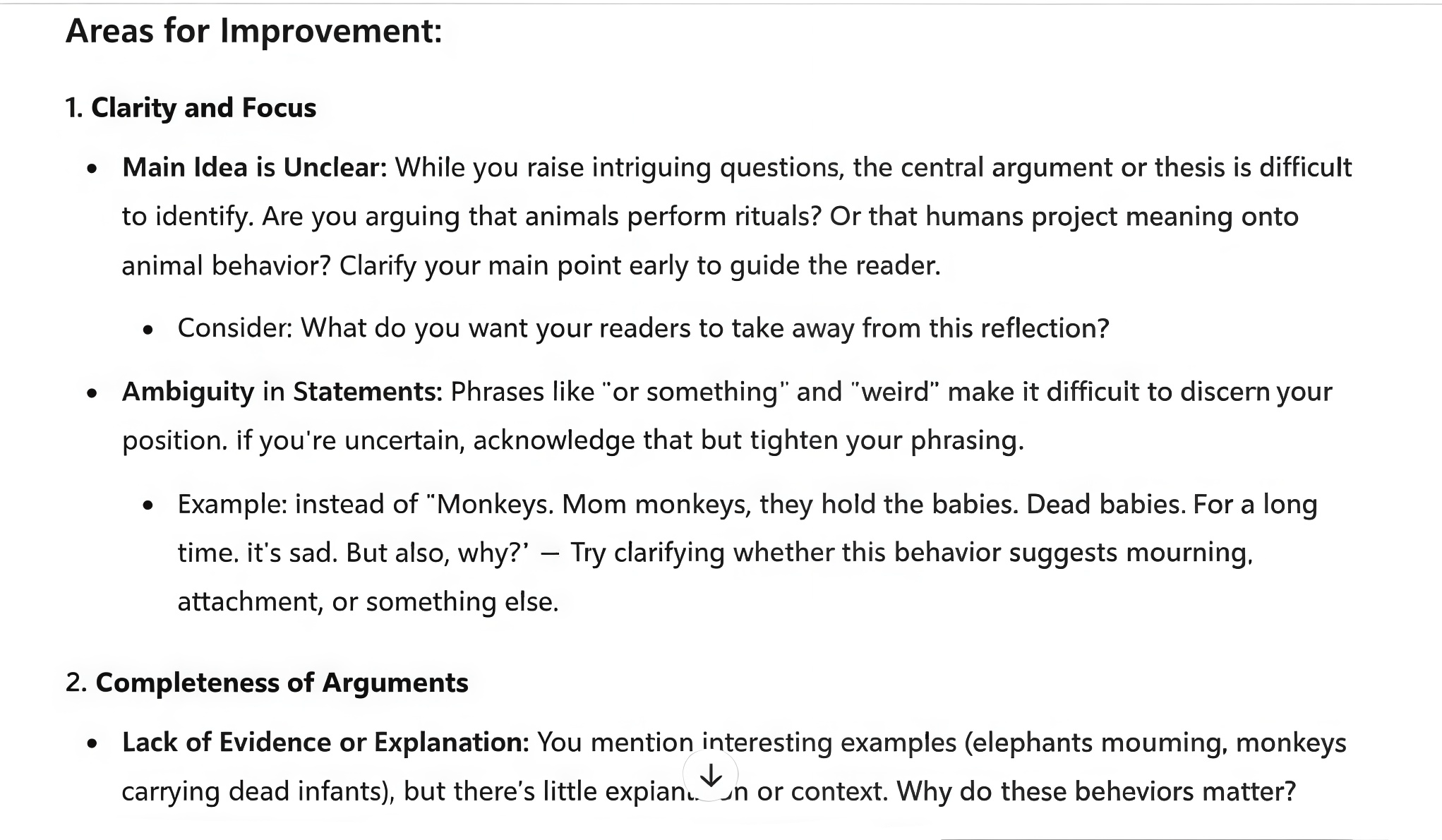
Documenting AI Use
If you allow learners to use generative AI throughout an assignment, it is important to give clear instructions on where generative AI can and cannot be used and how students should document and cite their use of generative AI.
Popular citation guidelines have been updated with guidelines for citing generative AI.
Name of Company/creator of generative AI Tool. (Year). Name of the generative AI program (model of program) [Large language model]. URL.
Example:
Microsoft. (2025) CoPilot (GPT-4). [Large language model]. https://copilot.cloud.microsoft
Author/Creator. “Name of chatbot.” Title of platform where accessed, Full URL, Date Accessed (optional).
Example:
Microsoft. “CoPilot”. CoPilot. https://copilot.cloud.microsoft March 25, 2025.
See the University of Waterloo’s Citation Guide for more details.
You can also state requirements on how you want students to document their use of generative AI in completing the assignment.
Consider the following questions:
The University of Waterloo has developed a tool for detailed documentation of generative AI use. See this resource from the University of Waterloo for more information.
Generative AI and other technologies are becoming more commonplace across professions and in our everyday lives. It’s important for learners to also understand how these technologies work and the limitations that they have. Otherwise, we risk normalising uninformed, and potentially harmful, use of generative AI technologies.
This might mean supporting the development of AI Literacy in your courses and assessments or exploring how generative AI tools are being used in your field by professionals.
As generative AI is being more commonplace in social and professional practices, it will be important for learners to understand these technologies, by examining the sociopolitical elements of AI development and use, learning how to use certain tools, exploring how AI models are trained, or critiquing outputs for problems of accuracy, bias, or other distortions of information. Some example activities are provided below.
Ask students to use generative AI in response to a prompt and examine the output for biases, including the lack of representation of approaches, concepts, cultures, economic standing, and more. This can create an excellent launch point for many discussions on the skills and knowledge needed for literacy and process checking.
Ask students to use generative AI tools to produce work and using the SIFT framework (shared in the section on AI Skills) or another evaluation tool, to verify the accuracy of the output.
Identify if/how generative AI or other AI technologies are being used in professional settings related to your discipline or field. Create an authentic assessment that mirrors these processes or applications. Ask students to not only complete the assignment but to reflect on the use of generative AI in these settings.
33
Awareness Reflection: PedagogyAn interactive H5P element has been excluded from this version of the text. You can view it online here:
https://ecampusontario.pressbooks.pub/aihighereducation/?p=845#h5p-46
An interactive H5P element has been excluded from this version of the text. You can view it online here:
https://ecampusontario.pressbooks.pub/aihighereducation/?p=845#h5p-60
34
or http://dx.doi.org/10.2139/ssrn.4475995 VII
35
The final aspect of AI Literacy is interconnectedness. This means understanding how the development and use of generative AI is complex. This complexity is much more pronounced than that of other Education Technologies because generative AI is a general-purpose technology that touches all facets of society. Generative AI is entangled in larger institutional, social, political, and cultural structures, all of which impact individual perceptions and use of generative AI tools as well as legislation, policy, and emerging practice. Because of this, AI Awareness requires the ability to understand the multiple factors that might be influencing generative AI at both the micro and macro level.
Examples of larger complexities impacting generative AI development include:
))))Exploring this complexity at the macro level in detail is beyond the scope of this resource. However, this interconnectedness has been demonstrated at the micro level throughout the previous sections on other components of AI Awareness. Our knowledge, skill, values, ethics, and emotional responses (affect) all impact each other and have a significant impact on if/how we choose to integrate generative AI tools into our teaching practices and classrooms.
36
Awareness Reflection: InterconnectednessAn interactive H5P element has been excluded from this version of the text. You can view it online here:
https://ecampusontario.pressbooks.pub/aihighereducation/?p=1455#h5p-48
An interactive H5P element has been excluded from this version of the text. You can view it online here:
https://ecampusontario.pressbooks.pub/aihighereducation/?p=1455#h5p-55
37
A great way to engage with the complexity of generative AI discourse is to join us in the Generative AI Challenge.
Share your own resources below:
An interactive H5P element has been excluded from this version of the text. You can view it online here:
https://ecampusontario.pressbooks.pub/aihighereducation/?p=1476#h5p-59
VIII
The Domains of AI-Awareness framework highlights the key domains that an educator needs to consider in order to make an informed decision on if/how to integrate generative AI into their teaching practices.
Knowledge: What do educators need to know about generative AI?
Ethics: What ethical considerations do educators need to be aware of when choosing to use/not use generative AI?
Affect: How can educators navigate their emotional response to generative AI technologies?
Skill: What do educators need to be able to do with generative AI?
Pedagogy: (How) can generative AI support teaching and learning?
Interconnectedness: How are generative AI technologies and practices impacted by larger institutional, social, and political factors?
One of the biggest challenges that generative AI presents to teaching and learning is the rapid pace at which the generative AI landscape is evolving. The capability of generative AI technologies is rapidly progressing and global discussions around legislation and policy are ongoing. Thus, AI Literacy is a continuous process of learning and reflection. Keep in mind that decisions that you make today on if and how to adopt these technologies into your teaching practice may be very different than how you approach generative AI in the future.
1
Academic Misconduct
Academic Misconduct is an intentional action taken by an individual to deceive their instructor, peers, or institution, often in an attempt to achieve a higher grade, gain course credit, or otherwise be recognized for performance not achieved.
Artificial Intelligence
Any technology or process that allows machines to mimic human cognition.
Machine Learning
A subset of Artificial Intelligence that uses statistical modelling or algorithms to identify rules or patterns in data.
Deep Learning
A subset of Machine Learning that uses artificial neural networks modelled on the human brain to identify rules or patterns in data.
Generative AI
A subset of Deep Learning that can use learned rules or patterns to generate new content.
Large Language Models
Large Language Models (LLMs) are computational models that are trained on huge datasets of text to recognize common patterns and relationships in natural language. They can be used for generating texts that mimic human language.
ChatBots
ChatBots are designed to simulate conversation. They can be built on LLMs, allowing them to provide more sophisticated responses to prompts. Note that not all chatbots are generative; many are rule-based, meaning they have a set of pre-defined responses to prompts and do not generate unique or original text.
Hallucinations
Generative models are subject to generating nonsensical outputs, such as words or phrases that don’t exist, grammatically incorrect text, references to articles or resources that don’t exist, or warped images.
Plagiarism
Plagiarism is the act of copying the words or ideas of someone else without proper attribution or recognition.
Pre-trained
Large Language Models are trained on massive amounts of text to allow them to learn patterns and relationships which allows them to generate new text. This training is completed before the LLM is released to the public.
Prompt
A prompt is the text that is provided to the system providing instructions on the desired output or the task being requested.
Examples of prompts:
For text-to-text:
For text-to-image
Scholastic Offenses
Scholastic Offenses are any forms of academic misconduct that undermine the evaluation process, and include, but are not limited to, plagiarism, cheating on an exam, submitting course work that has previously been submitted in other courses or programs without knowledge of the instructor, and other intentional actions of deception or fraud that impact evaluation and assessment. (https://www.uwo.ca/univsec/pdf/academic_policies/appeals/scholastic_discipline_undergrad.pdf )
2
Share your own examples or resources here.
An interactive H5P element has been excluded from this version of the text. You can view it online here:
https://ecampusontario.pressbooks.pub/aihighereducation/?p=589#h5p-59
3
The Domains of AI-Awareness Framework emerged in conversation with members of the Western University community and other colleagues across Canada and the world.
Although it would be impossible to recognize the individual influence of each person I’ve chatted to about generative AI, I would like to extend a specific thank you to the following people:
4
This resource will be updated regularly as the generative AI landscape changes, and as the Domains of AI Awareness framework is further refined. This page will document significant changes and provide PDFs of past versions.
If you have feedback, would like to report inaccuracies, typos, or other issues, please contact me at ddilkes2@uwo.ca or submit your feedback anonymously here.