- DSpace Home
- →
- eCampusOntario Open Community
- →
- Ontario OER Collection
- →
- View Item
JavaScript is disabled for your browser. Some features of this site may not work without it.
| dc.contributor.author | Carranza, Mirna | |
| dc.contributor.editor | Carranza, Mirna | |
| dc.contributor.other | Shah, Haleemah | |
| dc.date.accessioned | 2026-02-04T19:50:40Z | |
| dc.date.available | 2026-02-04T19:50:40Z | |
| dc.date.issued | 2024-09-01 | |
| dc.identifier | 5d6cfe88-1da2-4bf7-9c71-0e22f8badd4c | |
| dc.identifier.uri | https://openlibrary-repo.ecampusontario.ca/jspui/handle/123456789/2466 | |
| dc.description.tableofcontents | Chapter One: The Complexities of “Cause and Effect”: Colonization and Modernity | en_US |
| dc.description.tableofcontents | Chapter Two: The Colonial Grid and Colonial Conditioning | en_US |
| dc.description.tableofcontents | Chapter Three: The ability to assimilate: Understanding myself through the colonial grid | en_US |
| dc.description.tableofcontents | Chapter Four: A Cultural Mosaic: Canada’s Multicultural Policy Then and Now | en_US |
| dc.description.tableofcontents | Chapter Five: The Making of Whiteness | en_US |
| dc.description.tableofcontents | Chapter Six: What is Cross-Cultural Across from? | en_US |
| dc.description.tableofcontents | Chapter Seven: Helpers as Knowers | en_US |
| dc.description.tableofcontents | Chapter Eight: Migration as a Family Process | en_US |
| dc.description.tableofcontents | Chapter Nine: Working with Immigrants/Forced Migrants and Trauma | en_US |
| dc.description.tableofcontents | Chapter Ten: Gender as an Axis of the Colonial Grid | en_US |
| dc.description.tableofcontents | Appendix: List of Projects | en_US |
| dc.language.iso | eng | en_US |
| dc.publisher | OPEN Textbooks | en_US |
| dc.relation.isformatof | https://ecampusontario.pressbooks.pub/thecolonialmirror/ | en_US |
| dc.rights | CC BY | https://creativecommons.org/licenses/by/4.0/ | en_US |
| dc.subject | Decoloniality | en_US |
| dc.subject | Coloniality | en_US |
| dc.subject | Eurocentrism | en_US |
| dc.subject | Migration | en_US |
| dc.subject | Social work | en_US |
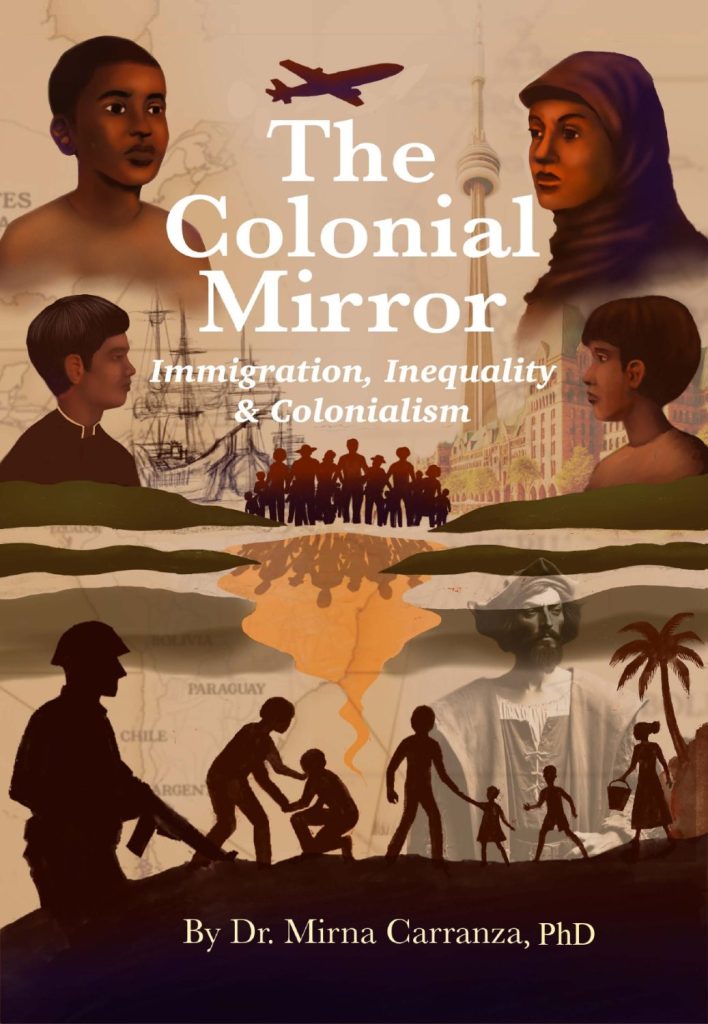
| dc.title | The Colonial Mirror : Immigration, Inequality & Colonialism | en_US |
| dc.type | Book | en_US |
| dcterms.accessRights | Open Access | en_US |
| dcterms.educationLevel | College | en_US |
| dcterms.educationLevel | University - Undergraduate | en_US |
| dcterms.educationLevel | University - Graduate & Post-Graduate | en_US |
| dcterms.educationLevel | Adult and Continuing Education | en_US |
| dc.date.updated | 2025-04-15 | |
| dc.identifier.slug | https://openlibrary.ecampusontario.ca/catalogue/item/?id=5d6cfe88-1da2-4bf7-9c71-0e22f8badd4c | |
| ecO-OER.Adopted | No | en_US |
| ecO-OER.AncillaryMaterial | No | en_US |
| ecO-OER.InstitutionalAffiliation | McMaster University | |
| ecO-OER.ISNI | 0000 0004 1936 8227 | |
| ecO-OER.Reviewed | No | en_US |
| ecO-OER.AccessibilityStatement | Yes | en_US |
| ecO-OER.AccessibilityURI | https://ecampusontario.pressbooks.pub/thecolonialmirror/front-matter/accessibility-statement/ | |
| ecO-OER.ORCID | https://orcid.org/0000-0002-6500-5537 | en_US |
| lrmi.learningResourceType | Educational Unit | en_US |
| lrmi.learningResourceType | Learning Resource | en_US |
| ecO-OER.POD.compatible | No | en_US |
| dc.description.abstract | This book explores the history of social work with newcomers through the lens of coloniality, which articulates what has been intentionally silenced, missed and how exclusion has been reproduced. This is especially pertinent to move towards the decolonization of education. Given Social work’s implication in the reproduction of the colonial encounter, the profession is in a unique position to shift its discourse and praxis. The social work relationships are predicated on the “knower” and the “known”, similar to the rescuer or hero narratives. In the past, therapeutic spaces have been visibly white and over time, this whiteness has been embedded in these relations- so as faces change, we can remain beholden to history. Agency and resiliency is not discussed, outside of the helper/helpee relationship, meaning that social work spaces often mirror colonial relations. The goal of this book is to understand how families, as a whole and the individual members, negotiate their placement on the Colonial Grid through resettlement in Canada. This is achieved by traversing through the history of social work and migration, to engage with the complicity of the profession of producing and reinforcing the Other. Of key importance is how Canadians, including social workers have been conditioned to understand immigration as “moving up”, “the search for a better life” and Canada as “provider and safe haven”, but most importantly the implication in fostering assimilation. | en_US |
| dc.subject.other | Humanities - History & Cultural Studies | en_US |
| dc.subject.other | Public Services - Education | en_US |
| dc.subject.other | Social Sciences - Sociology | en_US |
| dc.subject.other | Social Sciences - Gender & Sexuality Studies | |
| ecO-OER.VLS.Category | None | en_US |
| ecO-OER.VLS | No | en_US |
| ecO-OER.CVLP | No | en_US |
| ecO-OER.ItemType | Learning Resource | en_US |
| ecO-OER.MediaFormat | ||
| ecO-OER.MediaFormat | eBook | |
| ecO-OER.VLS.cvlpSupported | No | en_US |