DSpace Repository
Stand Back And Let It All Be : Cognitive Scaffolds To Help Academic Writing In Psychology
- DSpace Home
- →
- eCampusOntario Open Community
- →
- Ontario OER Collection
- →
- View Item
JavaScript is disabled for your browser. Some features of this site may not work without it.
| dc.contributor.author | Dawson, Michael R. W. | |
| dc.date.accessioned | 2026-08-20T19:53:51Z | |
| dc.date.available | 2026-08-20T19:53:51Z | |
| dc.date.issued | 2026-04-17 | |
| dc.identifier | 221cdc74-d086-4e4d-9129-1f8f3b12d5ed | |
| dc.identifier.isbn | 9781551955605 | en_US |
| dc.identifier.uri | https://openlibrary-repo.ecampusontario.ca/jspui/handle/123456789/2719 | |
| dc.description.tableofcontents | Introduction | en_US |
| dc.description.tableofcontents | Chapter 1: Embodied Cognition and Writing | en_US |
| dc.description.tableofcontents | Chapter 2: Scaffolding an Outline | en_US |
| dc.description.tableofcontents | Chapter 3: Scaffolding Initial Topics | en_US |
| dc.description.tableofcontents | Chapter 4: Scaffolding Drafting and Revising | en_US |
| dc.description.tableofcontents | Chapter 5: Your Writing World | en_US |
| dc.description.tableofcontents | Cited Literature | en_US |
| dc.language.iso | eng | en_US |
| dc.publisher | University of Alberta | en_US |
| dc.relation.isformatof | https://pressbooks.openeducationalberta.ca/standback/ | en_US |
| dc.rights | CC BY-NC-SA | https://creativecommons.org/licenses/by-nc-sa/4.0/ | en_US |
| dc.title | Stand Back And Let It All Be : Cognitive Scaffolds To Help Academic Writing In Psychology | en_US |
| dc.type | Book | en_US |
| dcterms.accessRights | Open Access | en_US |
| dcterms.educationLevel | University - Undergraduate | en_US |
| dc.identifier.slug | https://openlibrary.ecampusontario.ca/catalogue/item/?id=221cdc74-d086-4e4d-9129-1f8f3b12d5ed | |
| ecO-OER.Adopted | No | en_US |
| ecO-OER.AncillaryMaterial | No | en_US |
| ecO-OER.InstitutionalAffiliation | University of Alberta | en_US |
| ecO-OER.ISNI | 0000 0001 2190 316X | en_US |
| ecO-OER.Reviewed | No | en_US |
| dc.identifier.doi | https://doi.org/10.29173/oerqfacp0sb | en_US |
| ecO-OER.AccessibilityStatement | No | en_US |
| lrmi.learningResourceType | Learning Resource | en_US |
| lrmi.learningResourceType | Learning Resource - Book | en_US |
| ecO-OER.POD.compatible | No | en_US |
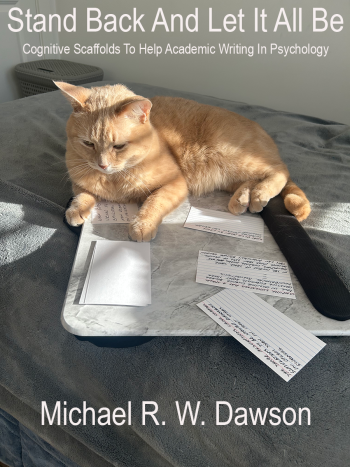
| dc.description.abstract | I explore why you might find academic writing challenging. I argue mentors often hide – and fail to teach – academic writing processes, leaving students to learn how to write on their own. Often students try to write by following incorrect assumptions about academic writing processes. I discuss incorrect assumptions and consider how changing your assumptions might change how you approach writing. Different assumptions about how academics write lead me to consider how ideas from embodied cognition can help academic writing. You do not need to know much about embodied cognition to take advantage of its ideas about writing. The only idea to keep in mind is embodied cognition’s proposal that thinking need not exclusively be ‘inside your head’ but also can be manipulating objects in the world. The book explores how you can use objects in the world to help your writing. | en_US |
| dc.subject.other | Humanities - Language & Linguistics | en_US |
| dc.subject.other | Social Sciences - Psychology | en_US |
| dc.subject.other | Support Resources - Learner Success | en_US |
| ecO-OER.VLS.Category | None | en_US |
| ecO-OER.VLS | No | en_US |
| ecO-OER.CVLP | No | en_US |
| ecO-OER.ItemType | Learning Resource | en_US |
| ecO-OER.MediaFormat | eBook | en_US |
| ecO-OER.MediaFormat | HTML/XML | en_US |
| ecO-OER.MediaFormat | en_US | |
| ecO-OER.VLS.cvlpSupported | No | en_US |